Colours and Materials in Fusion: The Art of Suzanne Belperron's Gemstone Combinations
A Visual Alchemy in Service of Form
From the 1930s onwards, Suzanne Belperron developed a style unique in its kind, at the crossroads of instinct and experimentation. Her work with stones was not merely about showcasing isolated gems, but rather an active pursuit of bold chromatic and textural harmonies.
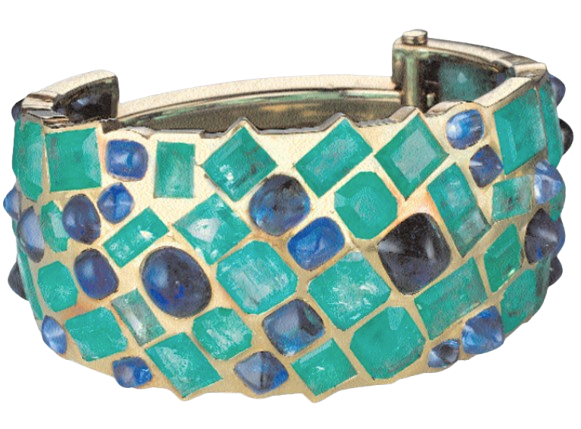
Rough emeralds, barely polished and irregularly shaped, are strung like common beads across multiple rows of necklaces or bracelets. This deliberate choice gives each piece an appearance that is both primitive and precious, reconnecting with the original idea of jewellery as an organic talisman.
Through this approach, Belperron transcended the norms of traditional jewellery-making and established a personal grammar built on contrasts, oppositions and emotional balance.
The Clash of Textures and Tones
Belperron's combinations of stones do not follow a purely aesthetic logic. They obey a search for creative tension. By blending barely faceted emeralds, translucent amethysts, intense rubies and sapphires with shifting reflections, the designer composed jewels that vibrate visually.
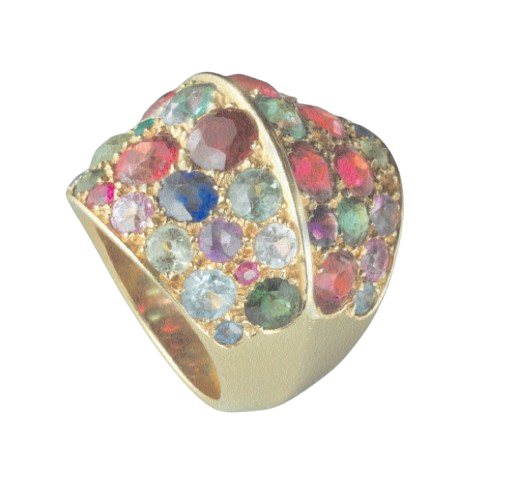
These plays of materials can be found in her cuff bracelets, sculptural brooches, and necklaces where semi-precious stones and noble gems intertwine. Everything is bound together by custom-crafted metal: yellow gold, white gold, sandblasted platinum, or sometimes simply raw material.
"It is not about juxtaposing, but about fusing. Each stone must have a reason for being, an emotional and formal place within the whole."
Intuition as a Method of Composition
Far from the pursuit of absolute perfection that dominates classic high jewellery, Suzanne Belperron embraced an element of instinct in choosing and combining stones. A single piece might bring together a milky white agate cabochon, a bevelled emerald and a crystalline smoky quartz.
What matters is the visual conversation between materials. Each stone becomes a note in a sensory score. Thus, some combinations create chiaroscuro effects, while others play on oppositions of cold/warm or matte/brilliant.
This instinctive and sensory approach echoes that of a couturier assembling rare fabrics. It is no coincidence that Belperron collaborated with fashion figures such as Molyneux and Marcel Rochas, with whom she shared a taste for luxurious simplicity and formal avant-garde.
A Style Recognisable Among All
The combination of stones and colours thus became a signature of the Maison Belperron. Whether in generously proportioned bracelets, floral clips or totem rings, the richness of chromatic harmonies gives them an immediately identifiable presence.
This audacity can be seen in the pages of American Vogue (June 1935), photographed by Horst P. Horst, where a Molyneux dress is accompanied by several Belperron pieces: yellow gold cuff bracelets adorned with emeralds, sapphires and rubies, along with matching rings.
A Living Chromatic Legacy
Today, this way of assembling stones continues to inspire contemporary designers. Where other houses settle for the safe pairing of gems, Belperron's approach remains a lesson in freedom and material creativity.
The works displayed in Olivier Baroin's galleries bear witness to this: the Belperron style relies less on the intrinsic value of the stones than on their sensitive resonance. A mineral poetry where each gem speaks to the body and the eye.