Jade in the Work of Suzanne Belperron: A Stone of Immortality and Refinement
Jade in the Work of Suzanne Belperron: A Stone of Immortality and Refinement
Among the stones that make up the mineral palette of Suzanne Belperron, jade holds a singular place. Prized for millennia in China as well as in Central America, laden with symbolism and mystery, it embodies a dialogue between East and West that runs through the designer’s entire body of work.
A fashionable stone during the Art Deco era, jade was one of Belperron’s favourite materials, which she incorporated into her creations with the same boldness and sensitivity she reserved for rock crystal, agate and aquamarine.
Jade: a sacred stone for millennia
Cherished by the Chinese for thousands of years, jade is far more than a mere ornamental stone: a pledge of immortality, it symbolises moral virtues in Far Eastern tradition. Its chromatic palette, of unsuspected richness, ranges from a very pale, almost whitish green to an intense green, through shades of mauve and pink.
Jade was also highly sought after in Central America, where its rarity made it an object of desire: Olmec sculptures and massive statuettes dating from Prehistory bear witness to this ancestral fascination. From the Neolithic period to the present day, jade has been used without interruption for jewellery, ritual objects and decorative items.
It was in India, under the Mughal dynasty in the seventeenth century, that the mastery of jade craftsmanship reached its zenith: the stone was frequently inlaid with gold threads and set with precious cabochon stones. This Mughal tradition of combining jade and gold was a direct source of inspiration for Suzanne Belperron, whose work drew extensively on the artistic influences of the Orient.
Jade: an emblematic stone of the Art Deco era
The enthusiasm for jade experienced a spectacular revival in the 1920s and 1930s, carried along by the wave of Orientalism that swept through European decorative arts. The great Parisian jewellery houses, from Cartier to Boucheron, incorporated this stone into their creations, drawn to its satin texture and subtle hues.
Suzanne Belperron, ever in search of materials capable of feeding her imagination, made jade one of her favourite stones. This choice testified to her enduring desire to rehabilitate so-called “modest” stones, long excluded from high jewellery, and to elevate them to the rank of noble materials through the sheer force of her art.
Suzanne Belperron’s jade creations
The carved white jade pendant
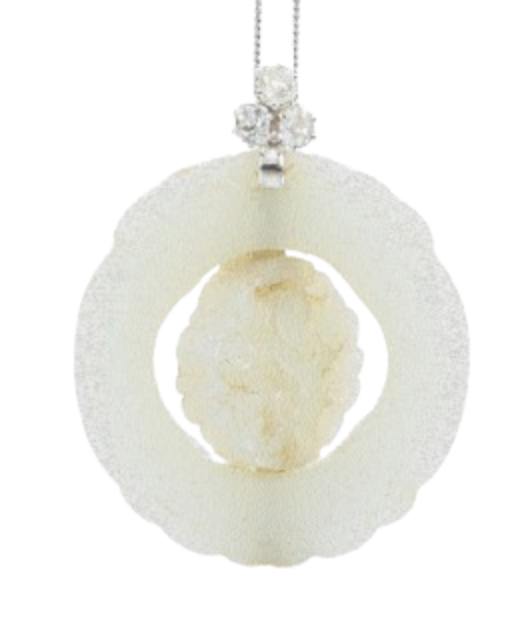
Among Suzanne Belperron’s personal jewellery cases was a pendant of great delicacy, composed of a double carved white jade motif, with a bail enhanced by three diamonds. This jewel, in its apparent simplicity, perfectly illustrates Belperron’s aesthetic: letting the material speak for itself, with the carving of the jade providing all the decoration, while the diamonds bring a discreet sparkle without ever competing with the main stone.
The choice of white jade – the most prized variety in Chinese culture, where it symbolises purity and wisdom – was no accident. It reveals the deep understanding Belperron had of Eastern traditions and her ability to extract their essence and transpose it into a resolutely modern jewellery language.
The oval white jade and yellow gold bracelet
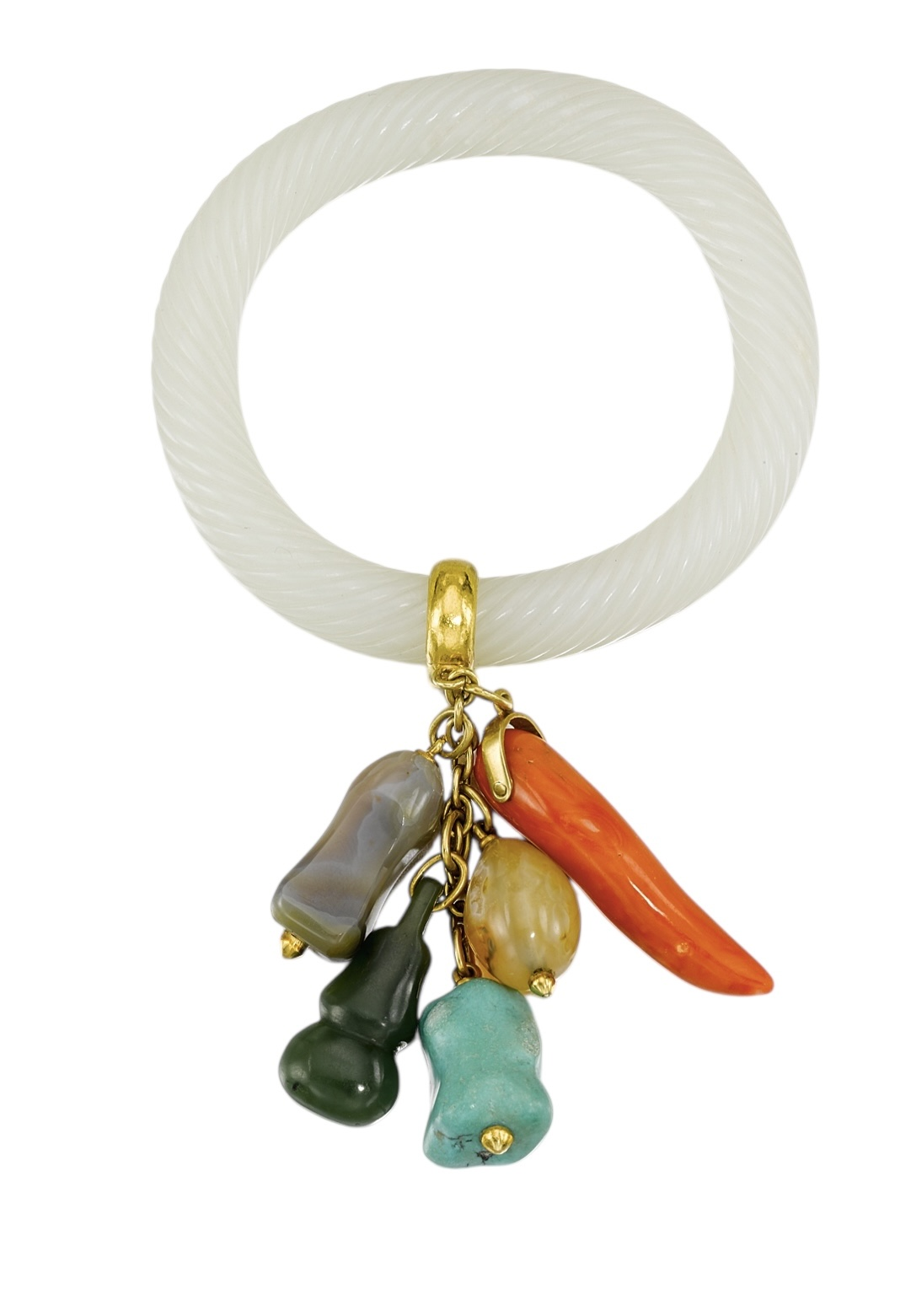
Among the designer’s personal jewels was also an oval white jade bracelet, carved with twisted gadroons, to which five charms in coral and hardstones were attached. This bracelet brings together several stylistic signatures dear to Belperron: the gadroon, a recurring motif in her work, found in her rock crystal creations as well as in white agate; the addition of colourful charms, lending the piece a joyful whimsy and natural movement; and the pairing of jade with yellow gold, a classic alliance inherited from the Mughal tradition.
Jade and lapis lazuli: the blue-green alliance inspired by India
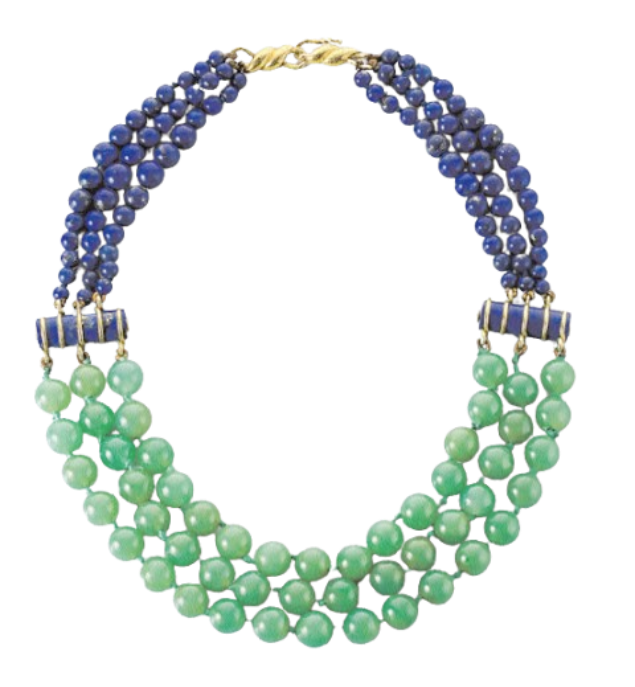
One of the most poetic combinations imagined by Suzanne Belperron brings together jade and lapis lazuli in a blue-green harmony directly inspired by India and its emblematic bird, the peacock. An iconic necklace, composed of jade and lapis lazuli beads linked by two “scroll” motifs in gold and lapis lazuli, embodies this vision: the deep blue of the lapis mingles with the soft green of the jade in a chromatic dialogue of great subtlety.
This alliance is part of Belperron’s broader fascination with Eastern civilisations. The Indian influence, in particular, permeates many of her creations: necklaces of baroque stones inspired by the parures of maharajahs, leaf motifs in the shape of boteh borrowed from Kashmiri shawls, and her predilection for bold mixtures of coloured stones found in her most celebrated creations.
Imperial jade in glass paste: the audacity of fantasy
A little-known fact that reveals the free spirit of Suzanne Belperron: the designer did not hesitate to use fantasy materials, such as glass paste imitating imperial jade. Her private jewellery case contained a fantasy demi-parure – necklace and bracelet – in black enamelled metal enhanced with glass paste beads imitating jade.
This choice, far from being a compromise, reflects an aesthetic philosophy in which the beauty of a jewel does not depend on the market value of its materials but on the rightness of its composition. It was this very conviction that led her to combine precious stones with so-called “modest” stones – chalcedony, carnelian, agate – in pieces of sovereign elegance.
The legacy of a vision: jade as a thread between cultures
Jade, in the work of Suzanne Belperron, is never merely a raw material: it serves as a conduit for dialogue between civilisations. China, Mughal India, pre-Columbian America and the Parisian elegance of the interwar years converge in these pieces, where every detail – a twisted gadroon, a gold thread, a coral charm – tells a millennial story revisited through a resolutely modern eye.
This unique ability to draw on traditions in order to extract a universal beauty is one of the most characteristic traits of Belperron’s genius. As the reference monograph devoted to her states, her sources of inspiration, “multiple and kaleidoscopic,” bear witness to her “insatiable curiosity” for artistic expressions of all origins.
To discover other facets of Suzanne Belperron’s work, explore our articles on her collaboration with René Boivin, her presence in fashion magazines and Olivier Baroin’s role in preserving her legacy.