Suzanne Belperron’s Experiments: When Precious Stones Become Artistic Expression
An experimental approach unique in the history of jewelry
In the demanding and codified world of fine jewelry, Suzanne Belperron established herself as a truly singular figure. While her contemporaries strictly adhered to classical principles of harmony, she chose to explore, to experiment, to dare. Her creations reflect a profound freedom one that stems, above all, from an intuitive, almost instinctive, relationship with the stone.
Suzanne's experiments are not mere stylistic trials.
They reflect a genuine philosophy of creation. For her, each gem possesses a personality, an energy, a story that the piece of jewelry must reveal. It is within this dialogue between material and imagination that her artistic language takes shape.
The boldness of a mastered gradient
One of Suzanne Belperron’s most striking experiments lies in her use of color gradients, or camaïeux. Going against the tradition of pairing stones that is, finding matching gems in size, shape, and color she deliberately chose to work with stones of varying intensities.
Where others might see imperfection, she saw richness. The nuances became variations, almost musical in nature. Sapphires were no longer selected to resemble each other, but rather to engage in dialogue. Pale blue, royal blue, deep navy the stone narrates a movement, a rise, a rhythm. The designer did not seek to impose uniformity; instead, she celebrated the subtle diversity within a single gemstone.
These gradients gave rise to vibrant ribbon-like bracelets, rings with three shades of blue, and spectacular necklaces composed of graduated topazes. Each piece embodies a vision that challenges the rules: beauty is no longer found in sameness, but in subtle transition.
Tone as the ultimate aesthetic criterion
Among Suzanne Belperron’s most iconic experiments is her unique approach to color. While traditional jewelry usually prioritizes clarity and purity, Belperron reversed that hierarchy.
For her, what truly mattered was tonal quality.
She chose colored diamonds pink, green, blue, yellow not for their rarity or market value, but for the precise shade that would serve her artistic vision. A slightly included stone with a vivid tone was far preferable to a flawless but lifeless gem.
This daring approach, ahead of its time, reveals a sensitivity closer to that of a painter. The stone became pigment. The jewel, a miniature canvas. Each element was selected to contribute to the overall composition, not to satisfy some rigid technical standard.
Notable examples of this vision include the Grappe de raisin clip, which combined blue and yellow sapphires, and a floral brooch from her personal collection. The latter features an elongated cushion-cut yellow sapphire surrounded by diamonds in varied shapes and fantasy hues. This composition perfectly reflects Suzanne Belperron’s chromatic experimentation, where each stone is chosen for its expressive nuance rather than strict conformity.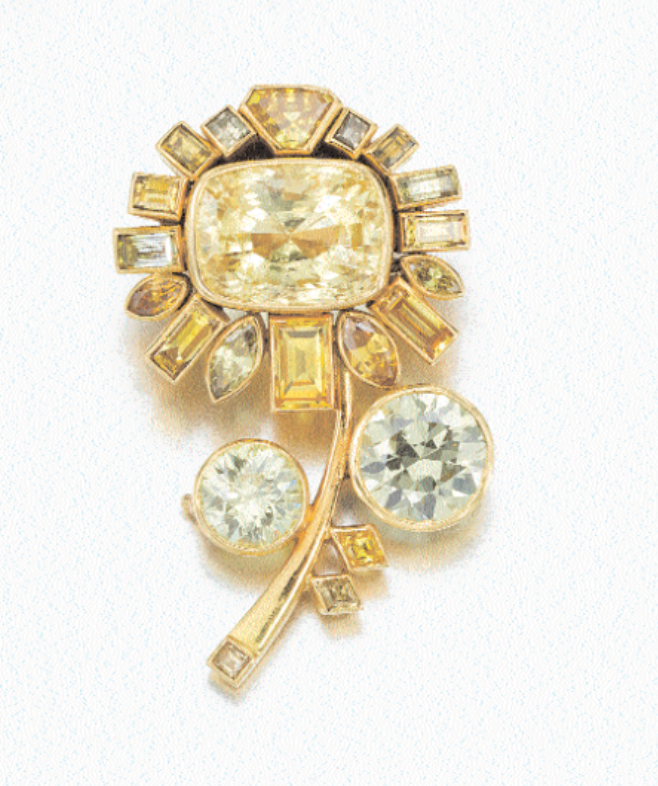
Contrasts meant to be emphasized, not neutralized
Suzanne Belperron’s experiments extended far beyond harmonious gradients. She also relished the confrontation of materials: transparent gems with opaque stones, the brilliance of a diamond with the milky softness of agate or the translucent glow of chalcedony.
For her, contrasts weren’t to be softened they were meant to be fully expressed.
This philosophy gave her jewelry a unique visual depth. Light, instead of scattering uniformly, clung to surfaces, bounced between materials, created shadows and highlights. A rock crystal ring might accentuate a navette-cut diamond; a chalcedony clasp might cradle a set of sapphire cabochons.
The jewel becomes sculpture.
The stone as the starting point of experimentation
Unlike jewelry houses that imposed a design onto the stone, Suzanne Belperron always began by listening to what the material had to say. Her experiments often stemmed from a single gem: a topaz with surprising reflections, a milky white agate, a sapphire with a tone so precise it inspired an entire piece.
She let the stone dictate the form its angles, its constraints, its curves. This creative process gave her pieces an almost organic dimension, as if they had grown naturally, like living forms.
A vision guided by instinct, not tradition
What makes Suzanne Belperron’s experiments so unique is that they are rooted in rare artistic instinct. She didn’t follow trends she created them. She didn’t adhere to codes she redefined them. She didn’t imitate any school she founded her own.
This vision allowed her to work not only with precious stones, but also with so-called semi-precious gems that were often overlooked at the time: agates, quartz, chalcedony, citrines, topazes… She saw in each of them an aesthetic potential others had ignored.
This freedom paved the way for a deeply modern form of jewelry, one based on experimentation and a constant search for new harmonies.
Suzanne Belperron’s experiments remain a major source of inspiration for today’s artisans, designers, and fine jewelry houses. Her way of considering the stone as a creative partner, her rejection of rigid perfectionism, and her bold approach to chromatic choices continue to shape contemporary jewelry.
More than a technique, Suzanne Belperron left us with a philosophy :
the true value of a jewel lies not only in carats, but in emotion.