Pearls in Suzanne Belperron's Work: Elegance from the Sea
Pearls in Suzanne Belperron's Work: Elegance from the Sea
Of marine origin, the pearl occupies a major place in the composition of Suzanne Belperron's jewellery. One of the oldest organic gems ever worn by humanity, it runs through her entire body of work, from fine pearls inherited from great antique jewels to cultured pearls born of Japanese discoveries. Through bracelets, rings and brooches, the designer once again reveals her signature: the art of combining materials for their light, and not for their price alone.
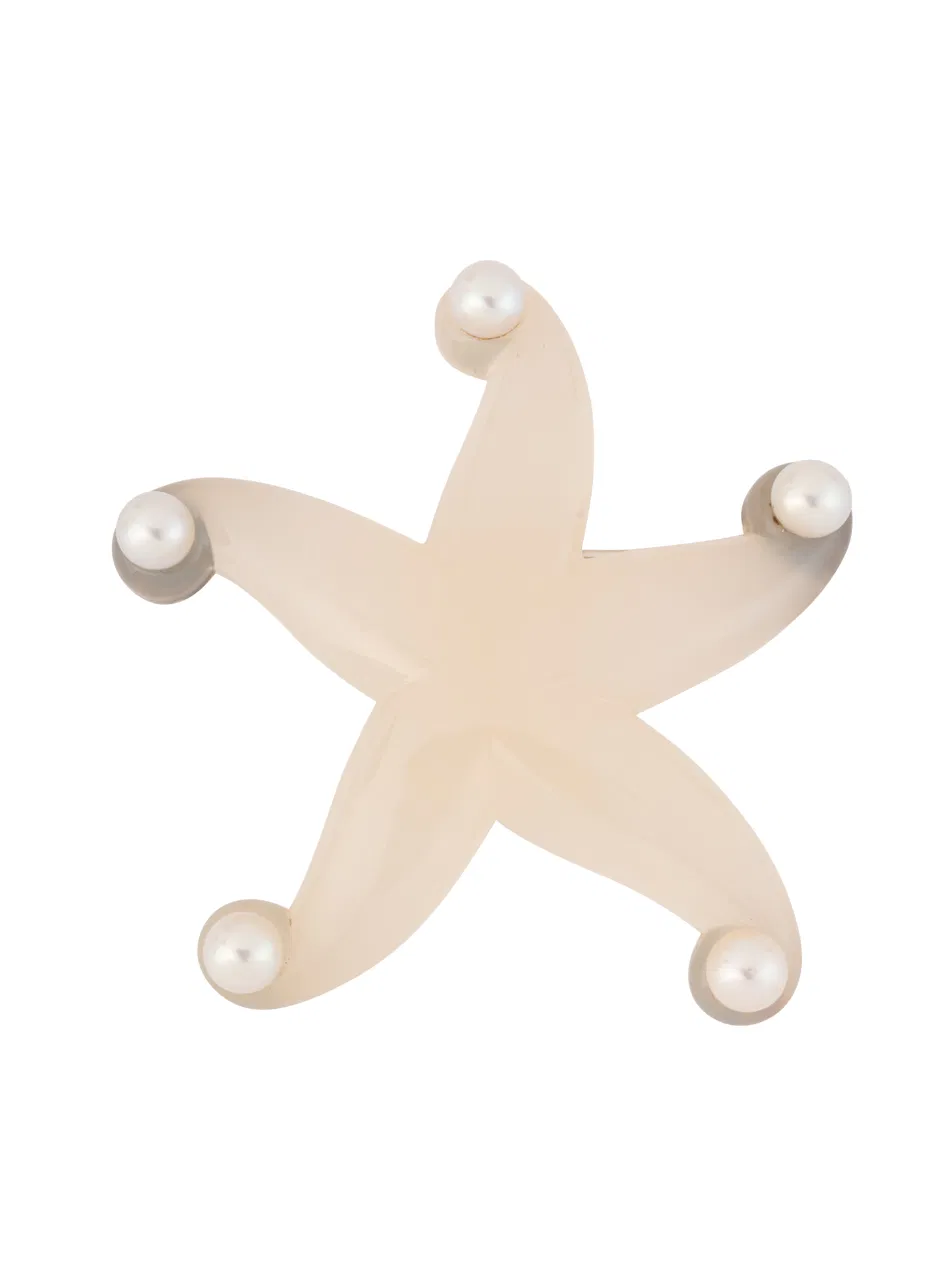
Pearls, a thousand-year fascination
The history of the pearl merges with that of civilisations. The earliest known text to mention it is said to be the Rig Veda, a Hindu religious collection dated from 1500 to 900 years before our era, and the oldest recorded pearl adornment is thought to date back to the 5th century BC.
In the West, the taste for pearls seems to have developed on the return from the Crusades, when knights, dazzled by the fabulous treasures of the Orient and Byzantium, brought back their radiance. Mounted in jewellery or sewn onto ceremonial garments, fine pearls aroused from then on an uninterrupted passion among kings and aristocrats, one that would never wane over the centuries.
Fine pearls and cultured pearls: the Mikimoto revolution
The 1930s marked a turning point. Fine pearls, formed naturally and of extreme rarity, gradually gave way to cultured pearls thanks to the discoveries of the Japanese Kokichi Mikimoto, who managed to artificially induce the secretion of nacre.
Suzanne Belperron occupied a singular position here. Owing to the great number of antique jewels that passed through her hands, fine pearls appeared frequently in her creations, at a time when they were becoming increasingly difficult to obtain. Yet she did not hesitate, on occasion, to turn to cultured pearls.
Bernard Herz, the dealer who opened the world of fine pearls to Suzanne Belperron
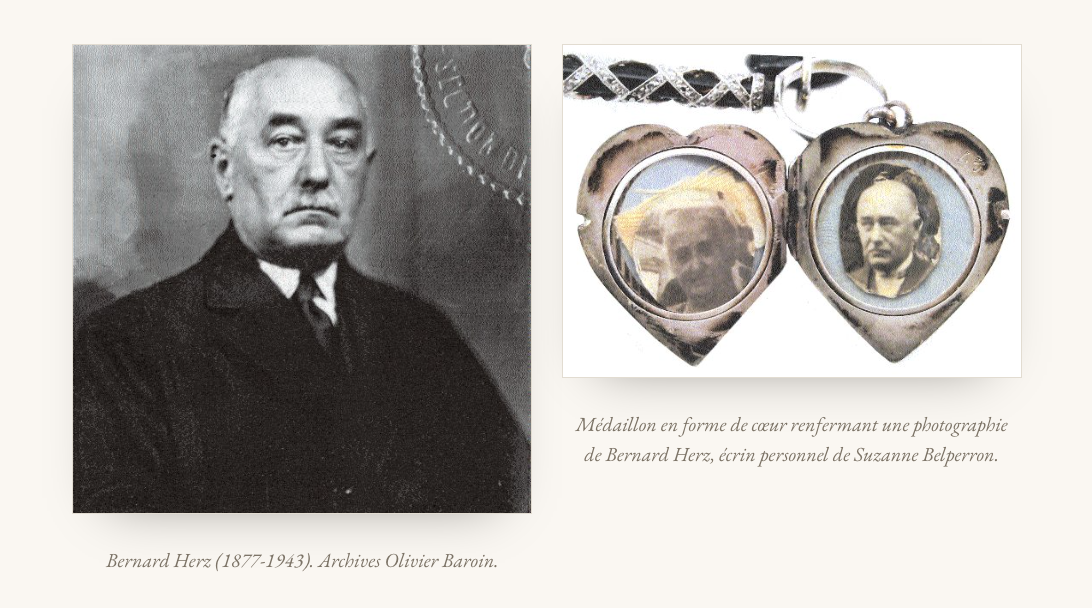
One cannot understand the place of fine pearls in Suzanne Belperron's work without mentioning Bernard Herz. In 1933, when she was already co-director of the René Boivin house, the designer accepted the proposal of this great Parisian dealer in pearls and precious stones to come and fulfil herself in complete freedom within his establishment.
She immediately left Boivin to join the Bernard Herz house.
Herz was among the greatest specialists in fine pearls in Paris. By granting her absolute trust, exceptional creative freedom, and then the reins of his company, he offered Suzanne Belperron, still very young, access to one of the finest stocks of fine pearls in the capital, at a time when these natural gems were becoming scarce. It is this resource, as much as the antique jewels that passed through her hands, that explains the so frequent presence of the fine pearl in her creations.
Mentor and most faithful supporter, Bernard Herz played a decisive role in Suzanne Belperron's rise. Everything suggests that they maintained a relationship as profound as it was passionate, and this shared passion multiplied the young woman's creative genius. Their collaboration, as fruitful as it was intense, gave the house a growing international reputation and durably anchored the fine pearl at the heart of its creative vocabulary.
The story came to a tragic end.
Of Jewish faith, Bernard Herz was arrested under the Occupation and then deported; he perished in 1943. Suzanne Belperron, who ran the house alone during the war years, remained faithful to his memory and, after the conflict, went into partnership with his son Jean, returned from captivity.
Fine pearls in Suzanne Belperron's creations
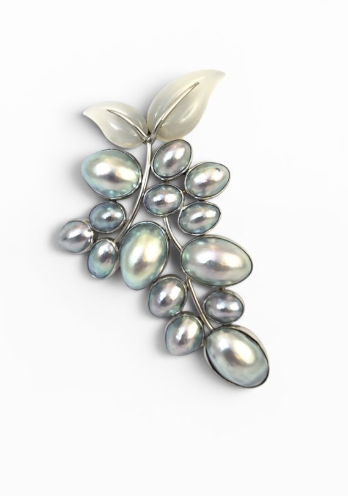
The designer's personal jewellery boxes bear witness to her attachment to the fine pearl. Among them are a fine pearl bracelet holding a heart-shaped charm enhanced with a diamond, a wave-patterned bracelet arranging polychrome fine pearls and diamonds, and a ring composed of fine pearls and diamonds.
This presence in her own jewellery speaks volumes: the pearl was not for her a mere material to order, but a substance she loved to wear and to set in dialogue with the diamond, in compositions always sober and structured.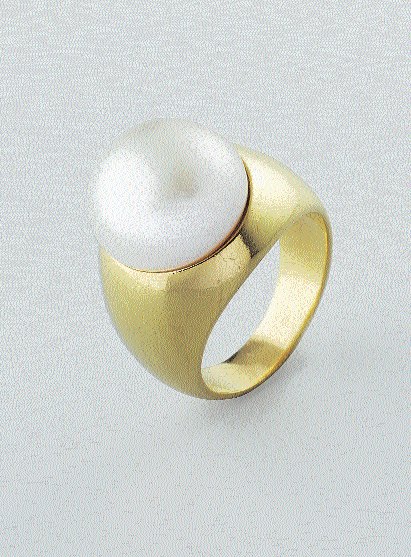
The Duchess of Windsor's bracelet
Among the most famous pieces is the triangular cuff bracelet that belonged to the Duchess of Windsor, made of gold and cultured pearls. This commission illustrates both the use Belperron made of cultured pearls and the prestige of her clientele, which counted among the most prominent figures of her time.
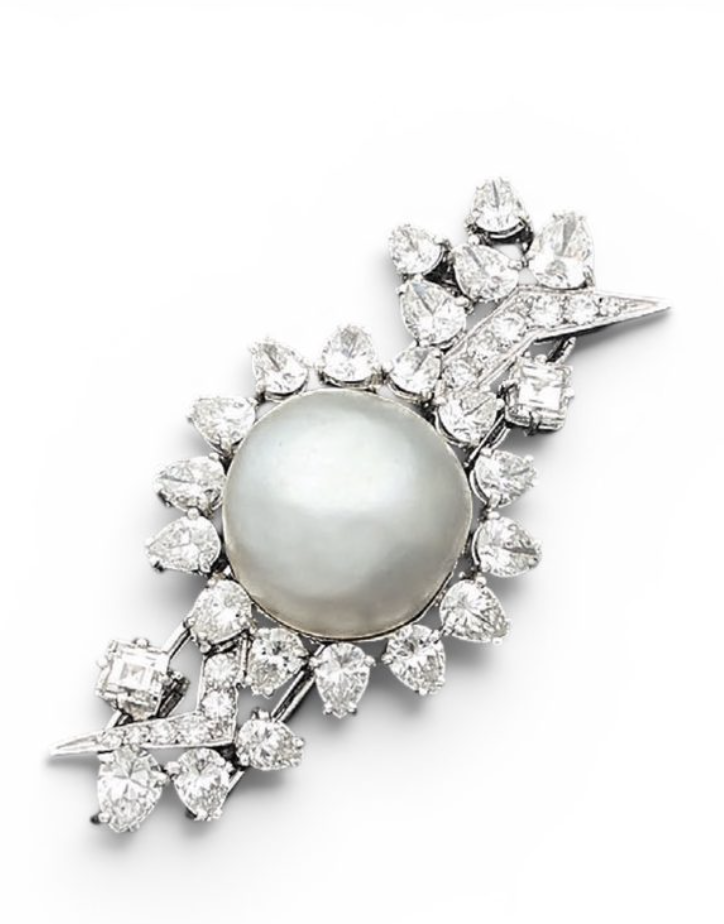
The art of combining pearls: diamond, rock crystal and aquamarine
Belperron's genius lies in her combinations of materials. The pearl becomes a point of light that answers the other gems.
A brooch mounted on grey gold and platinum thus combines an oval old-cut diamond of about 5 carats with two important pear-shaped fine pearls.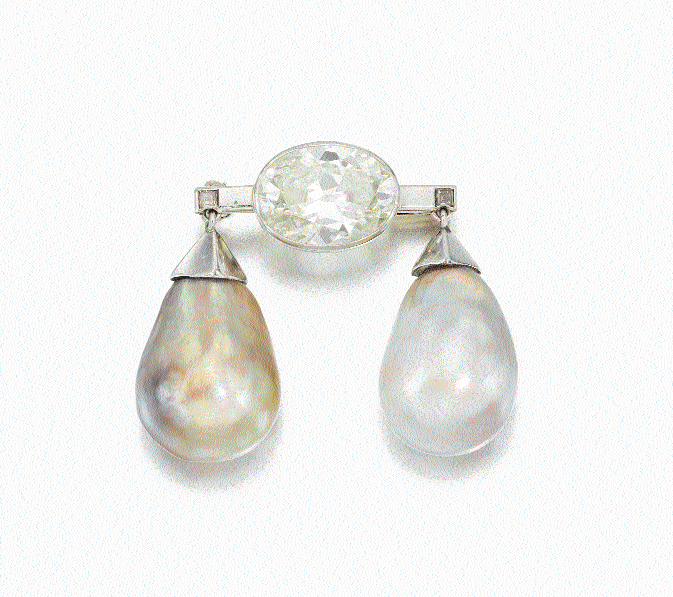
Several fine pearl bracelets mounted on platinum play, for their part, on the contrast with the mineral: one holds a rock crystal heart punctuated with a rose-cut diamond cluster, the clasp itself set with rose-cut diamonds.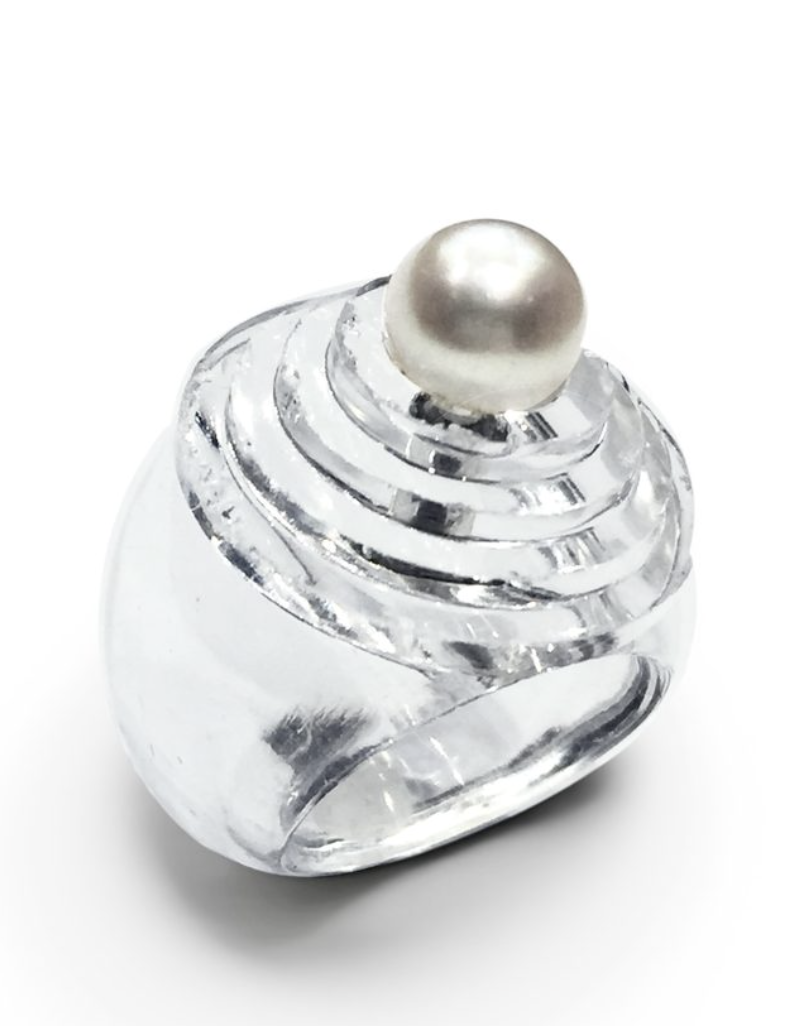
It is in this spirit that one of her most emblematic images belongs: in June 1935, American Vogue, photographed by Horst P. Horst, featured models in Chanel dresses adorned with Belperron jewels, including a spectacular bracelet carved from a block of aquamarine punctuated with pearls.
From bracelet to ring: the transposition of models
A ring circa 1935, mounted on platinum and grey gold, brings together polychrome fine pearls, old-cut diamonds and a baguette diamond (Groëné et Darde hallmark). Its original plaster cast, preserved in the archives, constitutes a precious testimony: it demonstrates that Suzanne Belperron transposed her bracelet models into rings, proof of a genuine stylistic grammar applied from one type of jewel to another.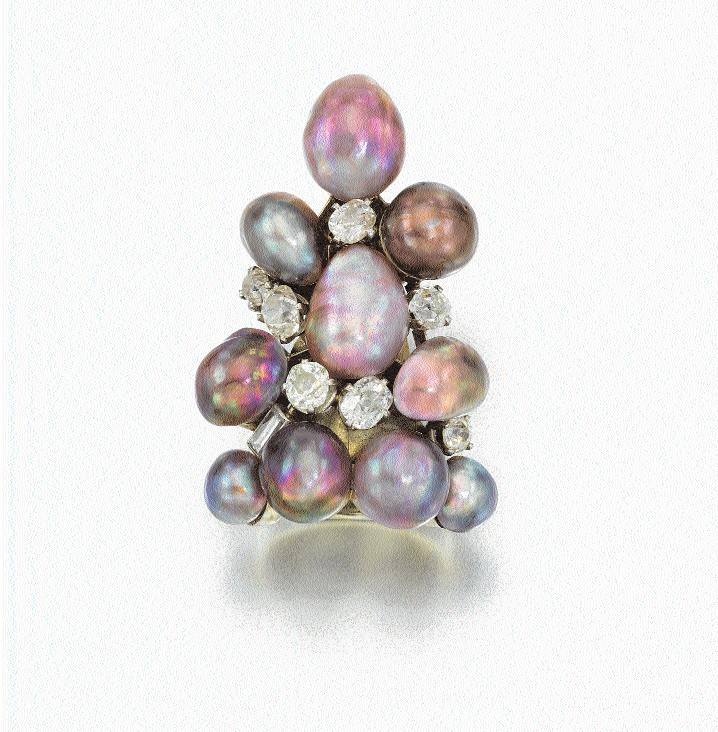
The importance of archives for authentication
As with rock crystal, agate or jewels carved from hard stones, the authentication of pearl creations poses a particular difficulty, since these materials cannot receive any signature hallmark. Only the archives rediscovered in 2007 by Olivier Baroin make it possible to trace the original order and to identify with certainty the authentic pieces of Suzanne Belperron. The original plaster casts, such as that of the ring circa 1935, play a decisive role in this work.
A heritage of marine light
By setting the pearl in dialogue with the diamond, rock crystal or aquamarine, Suzanne Belperron prolonged a thousand-year fascination while inscribing it in absolute modernity. Her pearl jewels, whether fine or cultured, continue to captivate collectors and to reach remarkable auction prices, faithful to her deep conviction: the value of a jewel lies not in the price of its materials, but in the harmony of their combinations.