Amethyst in Suzanne Belperron's Work: Purple in Majesty
Amethyst in Suzanne Belperron's Work: Purple in Majesty
Amethyst in Suzanne Belperron's Work: Purple in Majesty
Suzanne Belperron always knew how to reveal the singularity of gems beyond jewellery conventions. With amethyst, a stone laden with symbols present from Antiquity to the cover of Vogue in 1937, she deploys a palette of purples ranging from delicate parma to the most intense velvet. Heart rings, three-row cuff bracelets, Flower brooches with amethyst petals, aquamarine necklaces from which a cardinal stone is suspended: the designer makes this stone one of the protagonists of her chromatic universe.
Amethyst, a gem with a thousand nuances of purple
From parma to velvet purple
Amethyst, a transparent gem belonging to the quartz family, captivates certain jewellers for the extensive range of its hues, which offers them, according to their inspiration, a choice of delicate tones: parma or lilac, changing pink, glowing purple, or an incomparably intense velvet purple. This chromatic polyphony makes it a stone of choice for creators seeking subtlety.
A stone laden with symbols
Laden with symbolism, amethyst represents the ninth Tribe of Israel and appears on the breastplate of the high priest. It is also the stone that traditionally adorns the episcopal ring of bishops, conferring on the gem a spiritual dimension that has crossed the centuries.
The prophylactic virtue according to the Greeks
In Antiquity, the Greeks attributed to amethyst the prophylactic virtue of preserving its owner from drunkenness. This belief contributed durably to the symbolic value attached to the purple stone.
Appreciated at all times by jewellery creators, amethyst was particularly favoured in the 19th century, under the reigns of Charles X and Napoleon III, being one of the rare gems extracted from deposits in France. This geographical particularity inscribes amethyst in the history of French jewellery even before Suzanne Belperron reinvented it in her own creations.
Suzanne Belperron's bold alliances with amethyst
Suzanne Belperron dared all combinations, such as amethysts and yellow sapphires, or more classically, she associated amethysts with diamonds. This creative freedom unfolds equally in rings, bracelets, brooches, clips and necklaces.
The Flower ring with yellow sapphires and amethyst
Among the creations cited in the archives is a Flower ring with yellow sapphire petals and an amethyst heart. This composition embodies Belperron's chromatic signature, capable of marrying solar yellow with deep purple in a single piece where the central stone plays the role of a beating heart.
The ring with a cardinal heart-shaped amethyst
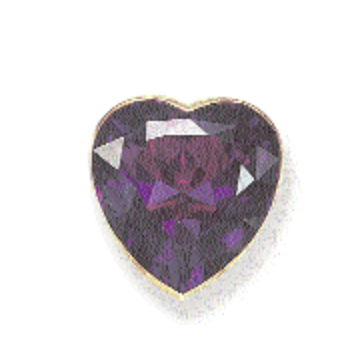
A yellow gold ring, set with an important heart-shaped amethyst of cardinal colour, bears witness to Belperron's predilection for stones of character. This piece, identified by Christie's, illustrates the place that cardinal amethyst occupies in the house's repertoire.
The cuff bracelet with three rows of amethysts
A cuff bracelet mounted on yellow gold, composed of three rows of amethysts interspersed with diamonds and gold beads, constitutes one of the most spectacular pieces of the designer's purple collection. Also documented by Christie's, this jewel demonstrates Belperron's ability to orchestrate volume and rhythm in a multi-row composition where each stone retains its readability.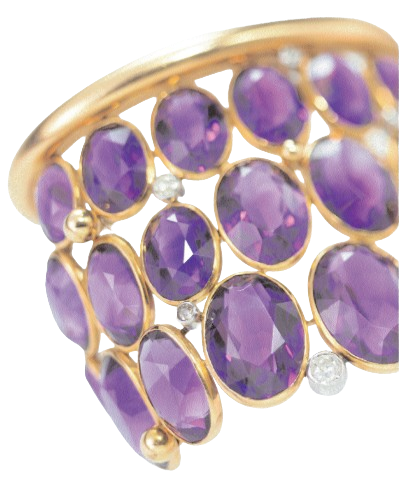
The Grape Cluster clip and the cover of Vogue 1937
In March 1937, the French magazine Vogue devoted its cover to an illustration by Raymond de Lavererie representing a Grape Cluster clip in amethysts by Suzanne Belperron. This publication constitutes one of the most emblematic media recognitions of the designer and bears witness to the status acquired by her amethyst creations as early as the end of the 1930s.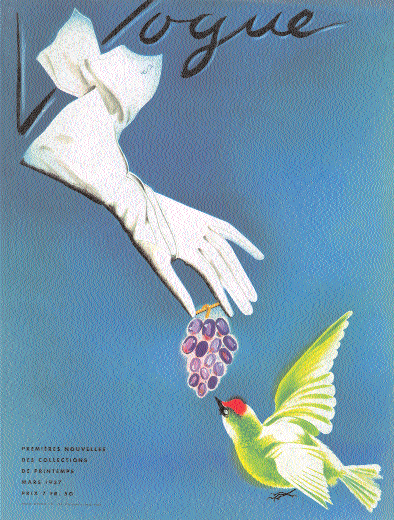
Amethyst in polychrome and Oriental compositions
The necklace with aquamarines and cardinal amethyst
Amethyst also appears in multi-gem compositions among the most inventive of the house. A superb necklace is thus composed of polished baroque aquamarines from which a cardinal amethyst and a rubellite are suspended, interspersed with another aquamarine. The clasp in hammered yellow gold is composed of two round rings with a diamond-shaped section forming a handcuff. This jewel, documented by Arthem, illustrates Belperron's art of orchestrating several gems around a master stone.
The Flower brooch with amethyst petals
Inspired by the floral motifs of the Japanese repertoire, Suzanne Belperron created several Flower brooches in different materials. Among them, a Flower brooch with amethyst petals and a heart in ruby, sapphire and diamond illustrates how the designer makes amethyst a petal in its own right, dialoguing with the red, blue and white stones of the heart. This piece is part of the Oriental vein dear to the house, in the lineage of Flower brooches with smoky quartz petals inlaid with cabochon emeralds.
A stone favoured by prestigious clientele
Ganna Walska, a purple passion
The Russian-born opera singer Ganna Walska, a regular client of Suzanne Belperron between 1 December 1937 and 7 January 1939 with sixty-five recorded appointments, would place important orders in which amethyst held a central place. Suzanne Belperron notes in her notebooks: "Topazes, amethysts Flower brooch; white agate ring after a design; amethyst, ruby, sapphire, topaz clip; gold and emeralds clip; amethyst belt; turquoise, amethyst necklace; Indian ruby and pearl brooch." This accumulation, ranging from the clip to the belt by way of the Flower brooch, bears witness to a genuine passion for the purple stone in the singer's repertoire.
The Count of Bismarck and the amethyst earrings
On 29 December 1951, the Count of Bismarck, secretary of Mrs Harrison Williams, brought to Suzanne Belperron's a pair of earrings in turquoises and brilliants and requested the same model in amethysts. During the same appointment, he mentioned three violet river pearls; Suzanne Belperron offered him three from her personal stock to submit to him a project for shirt-front buttons and cufflinks on mother-of-pearl. This anecdote, precisely dated in the archives, illustrates the trust granted to the designer for highly personalised amethyst orders.
The importance of archives for authentication
As with the other gems used by the Belperron house, the authentication of amethyst jewellery relies on rigorous expertise work. Unhallmarked pieces or those bearing only the workshop hallmark (Darde et fils in particular) can only be identified with certainty by cross-referencing their characteristics with the archives rediscovered in 2007 by Olivier Baroin. The appointment notebooks, which mention for example the orders dated 29 December 1951 or the series placed by Ganna Walska between 1937 and 1939, make it possible to trace the original order and to guarantee the authenticity of a creation of the house.
A purple heritage in majesty
From the cover of Vogue 1937 to the most secret pieces of Ganna Walska and the Count of Bismarck, by way of the cardinal heart ring and the three-row cuff bracelet, amethyst runs through the work of Suzanne Belperron in all its forms. As with her creations in tourmaline, aquamarine or turquoise, amethyst remains one of the major chromatic signatures of the house, a purple in majesty that traverses eras with the same intensity.