Suzanne Belperron and the Duchess of Windsor: Her Jewels
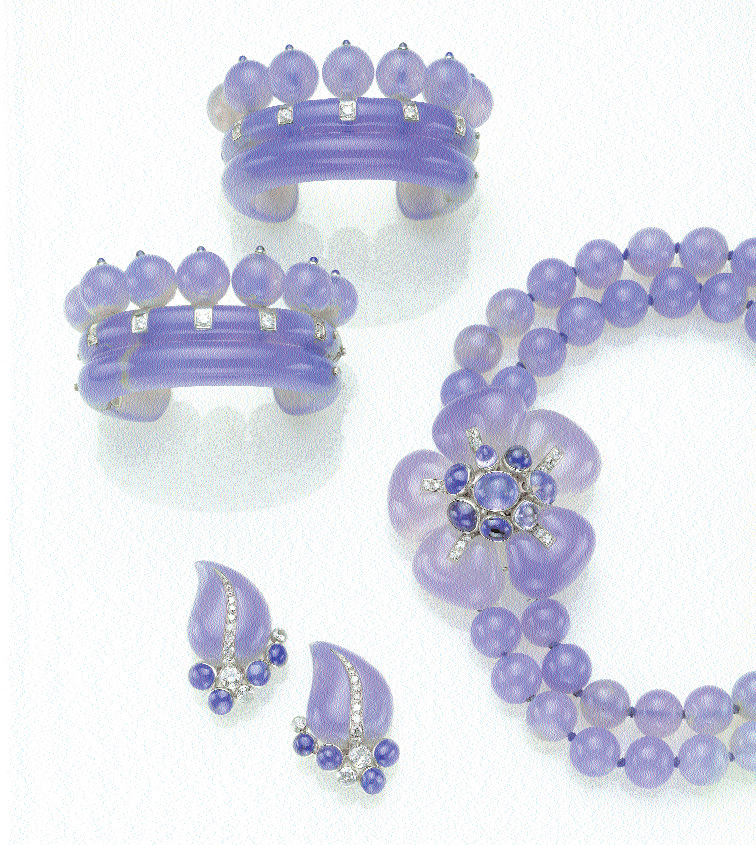
Parure that belonged to the Duchess of Windsor: two bracelets, each made of double open bands in blue chalcedony and diamonds, topped with blue chalcedony beads set with a sapphire cabochon; a two-row necklace of blue chalcedony beads joined by a flower with a heart of sapphire cabochons and diamonds; a pair of Leaf earrings in blue chalcedony, diamonds and sapphire cabochons. Sotheby’s.
Among Suzanne Belperron’s clients, none mattered more to her legacy than the Duchess of Windsor. From 1937 to 1972, her appointments and the Duke’s appear again and again in the designer’s diaries. And it was the sale of her jewels by Sotheby’s in 1987 that brought Suzanne Belperron’s work back into the light after years of neglect. Powder compact, parure, clips, bracelets: here are the Duchess of Windsor’s jewels designed by Suzanne Belperron, and what the archives tell us about each of them.
Key takeaways
• From 1937 to 1972, the Duke and Duchess of Windsor appear regularly in Suzanne Belperron’s appointment diaries.
• In 1937, the Duke commissioned a gold powder compact set with coloured stones as a gift for the Duchess.
• The blue chalcedony and sapphire cabochon parure is the most famous of her creations for the Duchess.
• The Sotheby’s sale in Geneva on 2 and 3 April 1987 marked Suzanne Belperron’s return to favour.
A loyal client of Suzanne Belperron
Considered throughout her life one of the most elegant women in the world, the Duchess of Windsor shared with her husband a boundless passion for jewellery. She was a regular visitor to Suzanne Belperron’s salons, as well as to those of her favourite jewellers, Cartier and Van Cleef & Arpels. Their appointments were so frequent and their orders so large that transcribing them all would be tedious.
A single day gives an idea of the scale. On 25 May 1938, the Duke left with a pair of earrings, a pair of clips, three rings and two Flower brooches. On 26 June, he ordered another pair of clips and another pair of earrings. The couple were among the house’s prestigious clients, alongside the Aga Khan, Daisy Fellowes and the singer Ganna Walska.
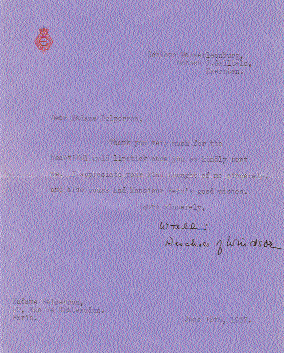
Letter from the Duchess of Windsor to Suzanne Belperron, 12 June 1937. Olivier Baroin Archives.
1937: the powder compact from the Duke
In 1937, Suzanne Belperron created for the Duke of Windsor, who gave it to the Duchess, a half-moon powder compact. Made of gold, it is set with multicoloured stones of various sizes: sapphires, rubies, emeralds, citrines and amethysts. The back is engraved with a map of Europe on which lines of red and blue enamel link various destinations, a souvenir of the couple’s many distant journeys. The Duke added a gold lipstick tube in a Hermès leather case.
The compact was one of the Duchess’s favourite accessories. Vogue reproduced it in an article entitled “The Duchess of Windsor, princess of elegance”. Such everyday objects, treated as jewels, hold a special place in Suzanne Belperron’s art of accessories.
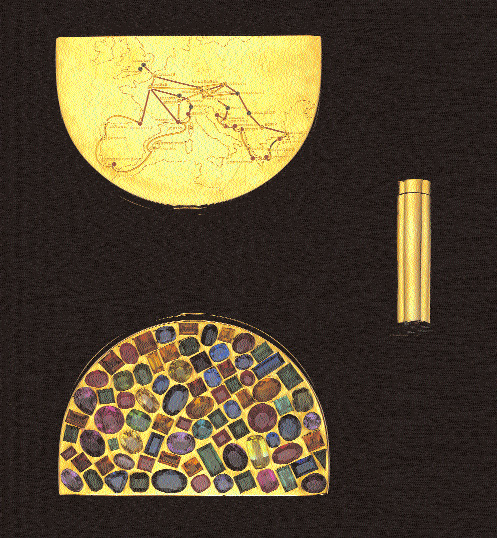
Yellow gold powder compact set with sapphires, rubies, emeralds, citrines, amethysts and other coloured stones, one of the Duchess of Windsor’s favourite accessories. Olivier Baroin Archives.
The blue chalcedony parure, from a painting to a clasp
Created in the 1930s, the blue chalcedony parure is the most famous of Suzanne Belperron’s creations for the Duchess. It comprises a two-row necklace of chalcedony beads, a pair of open bracelets whose crowns are topped with beads each set with a sapphire cabochon and brilliants, and a pair of leaf-shaped earrings with a vein of tapering brilliants.
The necklace clasp has an unexpected origin. Suzanne Belperron owned a 19th-century still life, an oil on panel. The flower painted in the lower left corner of the picture inspired the flower-shaped clasp, with its heart of sapphire cabochons highlighted by lines of brilliants.
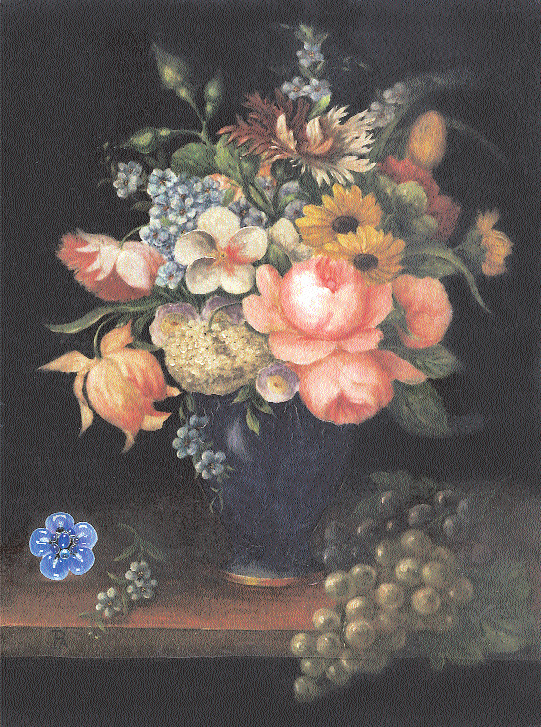
19th-century still life, oil on panel, that belonged to Suzanne Belperron. The flower in the lower left corner of the painting inspired the clasp of the blue chalcedony necklace made for the Duchess of Windsor. Olivier Baroin Archives.
Yet this clasp was not the first. The original drawing of the parure shows a necklace fastened by two chalcedony leaves. Later, the Duke wanted a larger brooch clasp, and the two leaves were turned into earrings. This is why the earrings are not a true pair: each of the reused motifs had been carved in the same direction for the original clasp.
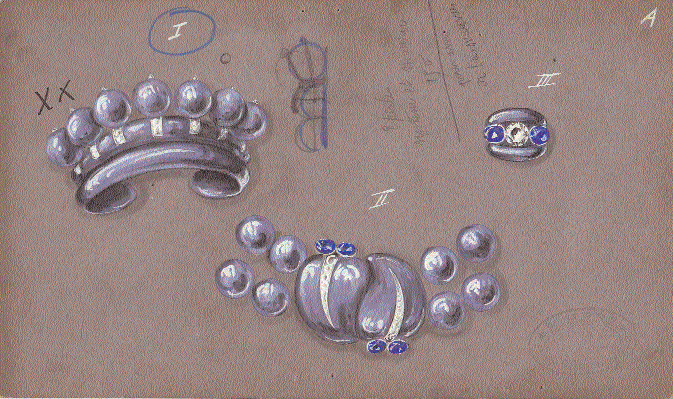
Original drawing for the Duchess of Windsor’s chalcedony parure. The necklace originally had a clasp made of two chalcedony leaves. Olivier Baroin Archives.
The Duchess wears the necklace beside the Duke in a photograph by Karsh of Ottawa. Cecil Beaton also photographed her in 1937 with her Flower clip in chalcedony, sapphires and diamonds and the matching pair of earrings, whose original gouache is kept in the designer’s archives.
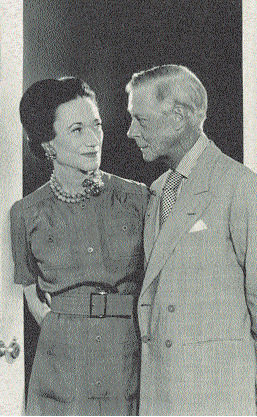
The Duchess of Windsor, with her husband, wearing the chalcedony necklace. Photo: Karsh of Ottawa.
Clips, a pearl cuff and emerald bracelets
Clips feature prominently in her orders. Photographed by Cecil Beaton for Vogue, the Duchess wears a double clip in rock crystal studded with cabochons.
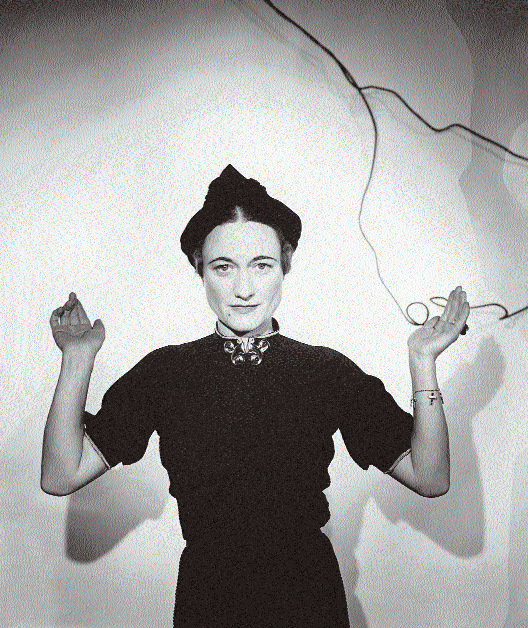
The Duchess of Windsor wearing a double clip in rock crystal studded with cabochons. Cecil Beaton/Vogue © The Condé Nast Publications Ltd.
She also owned a triangular cuff bracelet from the late 1930s, shaped like a tiara and covered with cultured pearls of different sizes mounted on gold. Suzanne Belperron usually preferred natural pearls, but she sometimes used cultured ones. Two bracelets, each made of a rigid yellow gold ribbon topped with pear-shaped emeralds, also belonged to the Duchess.
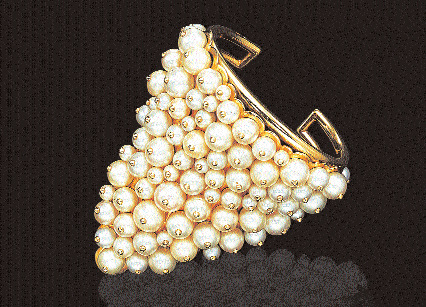
Yellow gold cuff bracelet entirely covered with cultured pearls, each one punctuated by a small conical rivet. Christie’s.
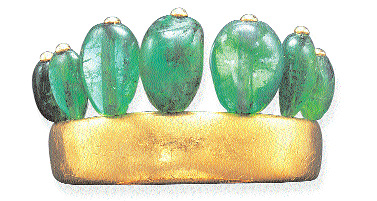
Bracelets that belonged to the Duchess of Windsor, each made of a rigid yellow gold ribbon topped with pear-shaped emeralds. Sotheby’s.
Her earrings even aroused envy. In a letter kept in the archives, Baroness Marie-Hélène de Rothschild admires the Duchess’s gold and diamond earrings. Keen to preserve the uniqueness of her jewels, Suzanne Belperron offered her other combinations of stones and metal based on the original design. As early as 1936, Harper’s Bazaar published a drawing by Valentine Hugo, a painter and friend of Suzanne Belperron, showing creations “by Mme Belperron of Herz”, including a brooch and earrings made for the Duchess of Windsor.
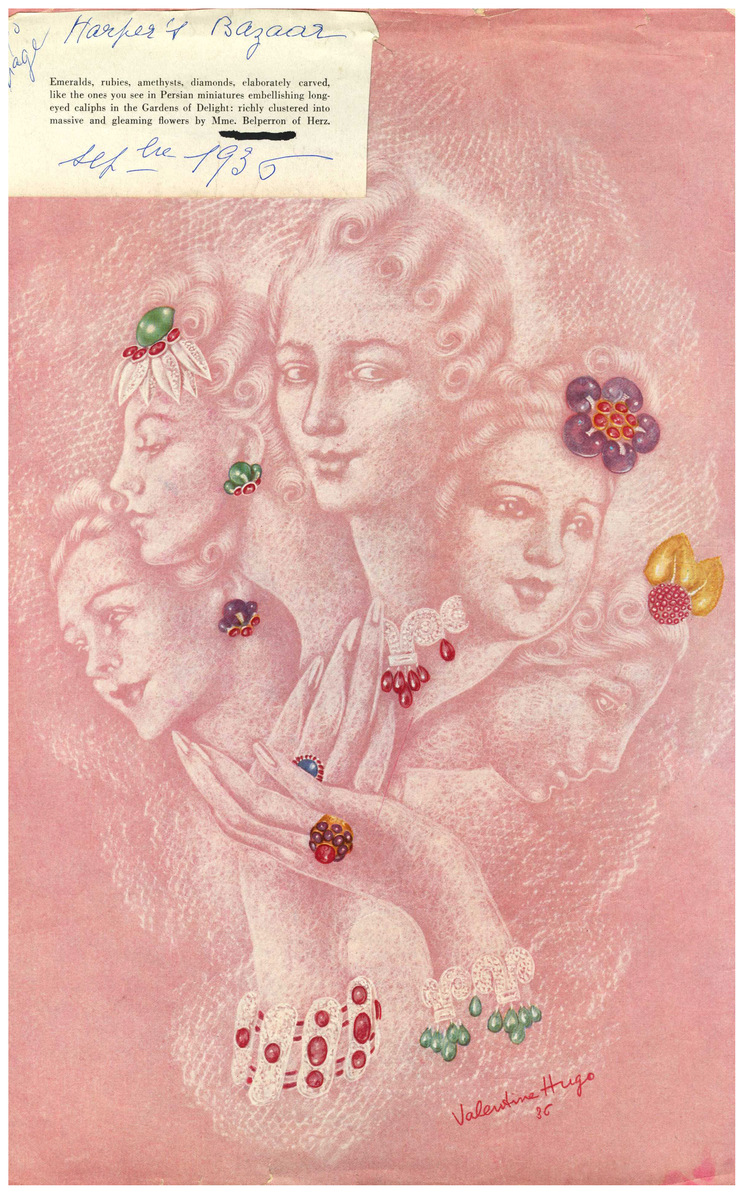
Drawing by Valentine Hugo, painter and friend of Jean Cocteau, Paul Éluard, André Breton and Suzanne Belperron. It shows many creations “by Mme Belperron of Herz”, some of which were made for the Duchess of Windsor (brooch and earrings). Harper’s Bazaar, September 1936. Olivier Baroin Archives.
1987: the sale of the Duchess of Windsor’s jewels
On 2 and 3 April 1987, Sotheby’s sold in Geneva the Duchess of Windsor’s prestigious collection of jewels, accessories and precious objects. Suzanne Belperron’s creations exceeded every estimate. Estimated at 6,000 to 8,000 Swiss francs, the chalcedony necklace sold for 275,000 Swiss francs. The bracelets, estimated at 3,000 to 4,000 Swiss francs, reached 220,000 Swiss francs, and the pair of earrings, estimated at 8,000 to 12,000 Swiss francs, 132,000 Swiss francs. The cultured pearl cuff, estimated at 3,000 to 5,000 Swiss francs, sold for 66,000 Swiss francs.
This sale put Suzanne Belperron back in the spotlight and paved the way for the recognition of her work by collectors around the world. As her jewels are not signed, their story is read today in her drawings, gouaches and appointment diaries, kept in the archives assembled by Olivier Baroin.