Africa in the Work of Suzanne Belperron
Africa in the Work of Suzanne Belperron
Among the distant influences that nourish the work of Suzanne Belperron, Africa holds a singular place. Where many of her contemporaries settled for a surface exoticism, she drew from it three far deeper things: a way of sculpting volume, a palette of hardstones and, above all, a technique, the hammering of gold.
African art, a revelation for the Paris avant-garde
In the early twentieth century, a passion for African art took hold among young painters, always quick to be fired by exotic discoveries. Vlaminck claimed to have been the first to receive the revelation of African statuary, which could then be seen in Paris at the ethnographic museum of the Trocadéro. His friends Derain, Matisse and Picasso succumbed in turn, going so far as to acquire masks and statuettes. Picasso's Les Demoiselles d'Avignon, painted in 1907 and inspired by these masks, inaugurated the aesthetic rupture of Cubism.
Two great events rooted this taste in the wider public: the Colonial Exhibition of Marseille in 1922, then that of 1931 at the Bois de Vincennes, which laid out before visitors the full range of cultures of the French colonial empire. In a lighter register, the Revue nègre triumphed in 1925 at the Théâtre des Champs-Élysées, led by Josephine Baker, who was herself a client of Suzanne Belperron.
An influence of form, not of pastiche
Europe's recent discovery of African art gave Suzanne Belperron the chance to indulge her deep attraction to exotic artistic expressions. But, true to her manner, she borrowed shapes rather than copying motifs.
The most obvious borrowing is a brooch made of an emerald carved in the form of a mask, framed by a stepped gold motif topped with emerald beads. Where her friend Elsa Schiaparelli did not hesitate to mount an African mask as a fan, Belperron transposed: the mask becomes a stone, the form becomes a jewel. The gouaches preserved in the archives show the project beforehand, on her characteristic grey card.
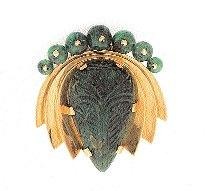
African Mask brooch in yellow gold, with a stepped design bordered by emerald beads and set with an important carved emerald.
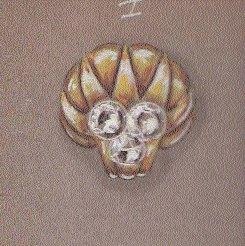
Gouache, design for an African Mask in yellow gold and diamonds. Olivier Baroin Archives.
Tribal-inspired necklaces
Suzanne Belperron's eye surely fell on the imposing necklaces created by the artisans of Africa's various peoples, made of several rows and set with silver discs alternating with hardstones. From this observation sprang a whole family of creations: necklaces of African inspiration composed of multiple circles, multi-row ornaments, and designs for necklaces, bracelets and earrings explicitly described as “African.”
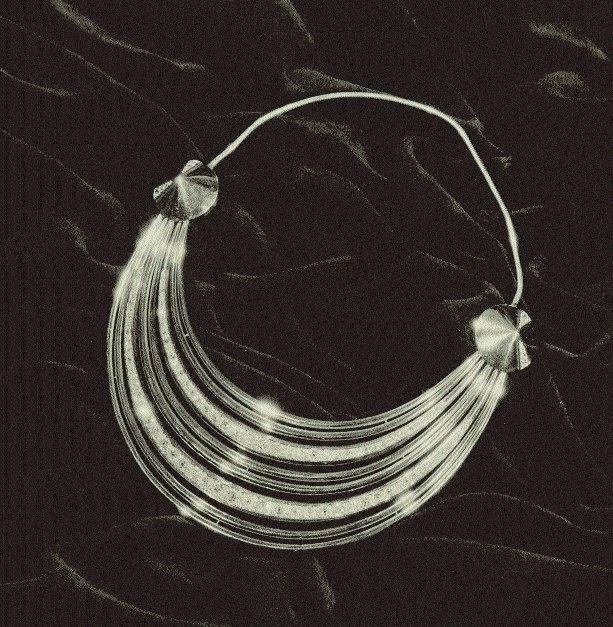
Necklace of African inspiration composed of several rows, joined by two gold motifs.
These tribal discs often bear an engraved spiral motif, a universal symbol of eternity found from the highest Antiquity to the present day, one that would become emblematic of her work. Many of Suzanne Belperron's drawings develop these sources into endless variations, revisited again and again over the years.
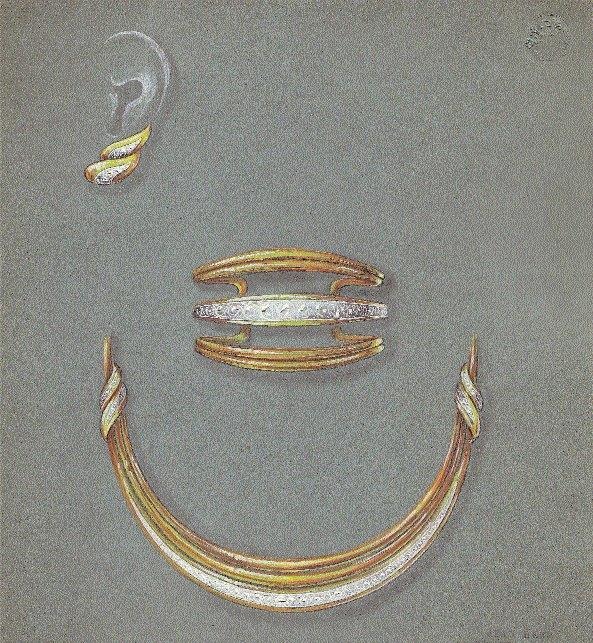
Gouache, design for a necklace, bracelets and earrings described as “African” in yellow gold, platinum and diamonds. Olivier Baroin Archives.
Hammered gold, a know-how from Africa
This is perhaps the deepest borrowing of all, for it no longer concerns form but technique. From Suzanne Belperron's knowledge of the various techniques of African craftsmanship came her use of hammering, which gives shape to a sheet of metal through small taps of the hammer.
For many of her jewels she used a 22-carat gold of a warm, dense yellow, more malleable than 18-carat gold, to give them the look of unearthed treasures. Her Helmet ring in hammered yellow gold thus has the appearance of a nugget, and her stylised Shell brooch evokes a fossil barely freed from the sand.
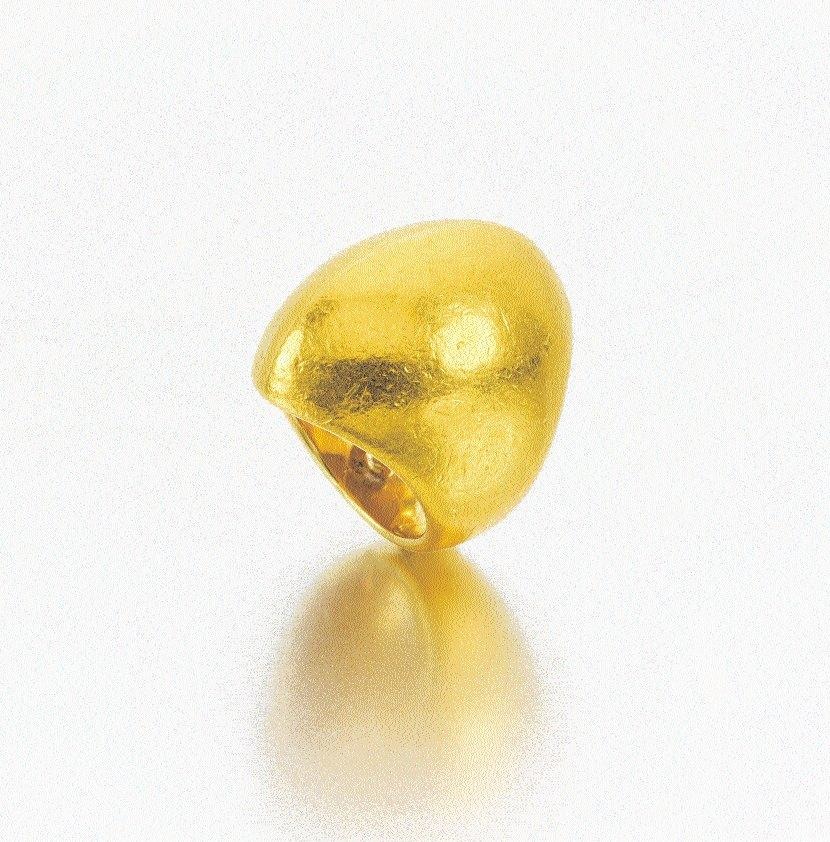
Helmet ring in hammered yellow gold, with the look of a nugget. Suzanne Belperron’s own jewellery box, private collection.
Alt: Helmet ring hammered yellow gold Suzanne Belperron
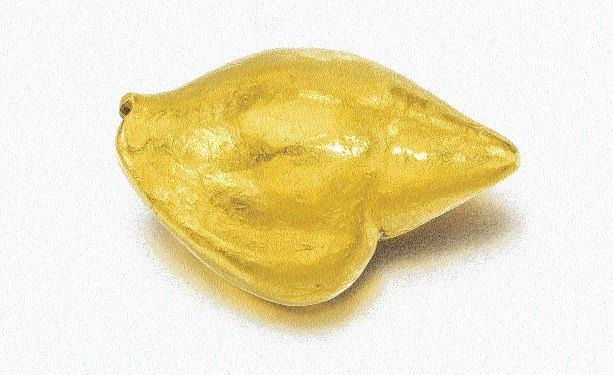
Stylised Shell brooch in hammered yellow gold, evoking a fossil barely freed from the sand. Maker’s mark Darde et fils. Suzanne Belperron’s own jewellery box.
The Yin and Yang ring, born of the same vein
From this same exploration of hammered gold comes one of the designer's most intimate pieces: her own engagement ring, known as Yin and Yang, made of hammered yellow gold and set with an old-cut diamond given to her by her future husband, Jean Belperron. Created in 1923, this avant-garde jewel still inspires many jewellers today. The same vein runs through the hardstones she loved, quartz, chalcedony, carnelian and coral, which she restored to honour for their intrinsic beauty, as she did with rock crystal
An influence absorbed, never imitated
Suzanne Belperron's Africa is not a stage set. She pinned neither masks nor fetishes onto her jewels: she drew from it a lesson in sculpture, a palette and a workshop gesture, which she dissolved into her own language. That is the mark of great creators, turning an influence into a style. As with all her creations, only the archives rediscovered by Olivier Baroin make it possible today to identify and authenticate these pieces, which their lack of signature would otherwise render impossible to attribute with certainty.