Egypt in the Work of Suzanne Belperron
Egypt in the Work of Suzanne Belperron
Among the influences that run through the work of Suzanne Belperron, Egypt holds a singular place. Not that of a fashion the designer happened to follow, but that of a memory she had lived. While all of Paris was enthralled by the treasures of Tutankhamun, she did not content herself with walking the Egyptian galleries of the Louvre: in the autumn of 1923, she set sail on a cruise up the Nile. From that journey would come a Pyramid brooch, a lasting fondness for the lotus flower, and a palette of stones borrowed from the banks of the Nile.
Egyptomania, a fascination born with Bonaparte
Europe's interest in the civilisation of the Nile dates back to the late eighteenth century. In 1798, Bonaparte launched the Egyptian campaign accompanied not only by soldiers, but also by archaeologists and scholars who produced architectural surveys and sketches in great number. On his return in 1802, the most celebrated of them, Vivant Denon, published Voyage dans la Basse et Haute-Égypte, a lavishly illustrated work that became a major source of inspiration for the applied arts.
Under the Consulate and in the first years of the Empire, women wore jewellery inspired by ancient Egypt, while furniture, bronzes and porcelain were covered with Egyptian decorative motifs. This became known as the Retour d'Égypte style. In December 1808, Napoleon presented Joséphine with a tea service made at the Manufacture de Sèvres and decorated in the Egyptian manner after Vivant Denon. Throughout the nineteenth century, a succession of temple discoveries sustained the enthusiasm for Egyptian archaeology.
1922: Tutankhamun rekindles the fever among jewellers
By the late nineteenth century, Cartier, Mellerio, Boucheron, Baugrand and Lalique were making abundant use of Egyptian motifs in their creations, and the trend took hold across the trade in the early twentieth century. But it was the discovery, in 1922, of Tutankhamun's tomb near Luxor by Howard Carter and Lord Carnarvon that caused a genuine shock. Countless press articles seized upon it: Egyptomania was back.
While Egypt's hold on the Western imagination was nothing new, the growth of newspapers and books gave artists unprecedented access to artistic expressions far removed from their own.
Unlike other designers, Suzanne Belperron saw Egypt for herself
This is where her path diverges. Unlike certain designer-creators, Suzanne Belperron did not content herself with visiting the Egyptian galleries of the Louvre. In the autumn of 1923, on the occasion of her engagement, she embarked on a cruise to Egypt with her future husband Jean Belperron and a couple of friends.
A single image of that journey survives, preserved in her archives: a photograph showing her on camelback, in a white dress and turban, surrounded by fellow travellers before the pyramids of Giza. This unique document changes the very nature of Egypt's influence on her work. Where others transposed motifs seen in a display case or an engraving, she drew on lived experience, which explains the freedom and restraint with which she would treat these references.
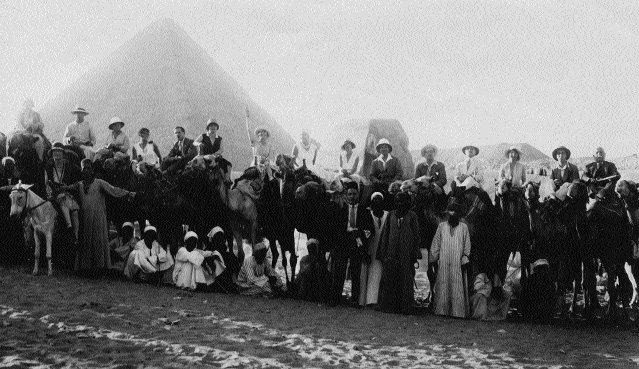
Suzanne Belperron (centre, in a white dress and turban) before the pyramids of Giza. Olivier Baroin Archives.
Lord Carnarvon, a client of Suzanne Belperron
The connection with Egypt took an unexpected turn some years later. In 1940, during a stay in Paris, Lord Carnarvon, sixth of the name and son of the Egyptologist who uncovered Tutankhamun's tomb, met the designer as a client. An extract from her archive ledgers records his stay at the Ritz, dated 20 March 1940.
In a letter written in her own hand on 10 October 1944, Suzanne Belperron recalled the pleasure she had taken, shortly before the war, in designing jewellery projects for Lord Carnarvon, projects she had been unable to carry out because of events.
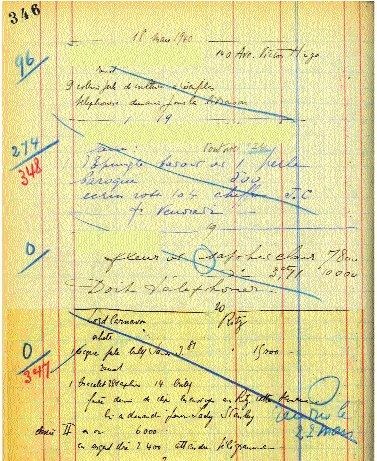
Archive extract, Lord Carnarvon, sixth of the name, during his stay at the Ritz, Paris, 20 March 1940. Olivier Baroin Archives.
The Pyramid brooch, an echo of the journey
A direct echo of her travels, the pyramidal form inspired a brooch in platinum and white gold, enhanced with geometric motifs in white agate punctuated by lines of diamonds. The piece sums up her approach: no literal quotation of ancient Egypt, but a pure form reduced to its essential geometry, carried by the contrast between the milky opacity of the agate and the brilliance of the diamonds.
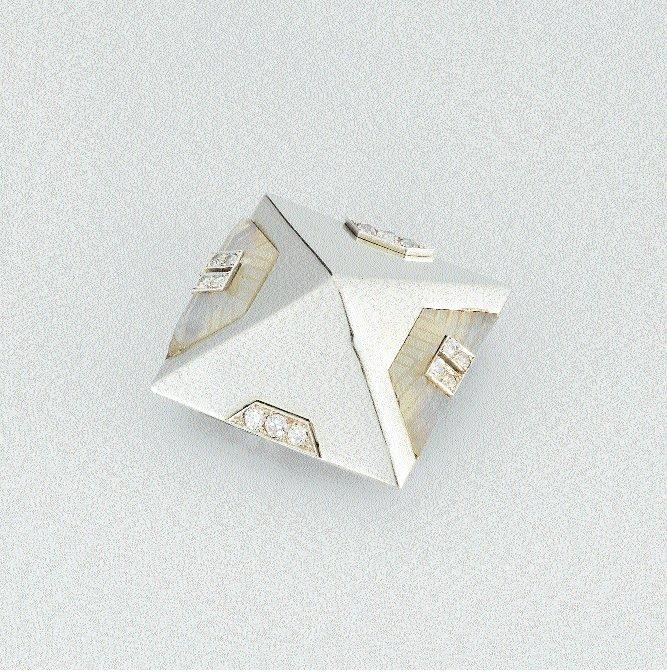
Pyramid brooch in platinum and white gold, set with white agate motifs punctuated by diamonds. Private collection.
The lotus flower, adopted for its graphic beauty
Within the profusion of her floral repertoire, it comes as no surprise to find the lotus flower, adopted for its graphic beauty. The motif forms the ornament of several models, worked in different materials.
The most striking of them is a double clip in enamelled gold, whose open corollas fan out across a design of diamonds, calibrated emeralds and black enamel, punctuated with coloured stones. The composition transposes the flower of the Nile into a resolutely Art Deco vocabulary: radiating lines, bold contrasts, controlled symmetry.
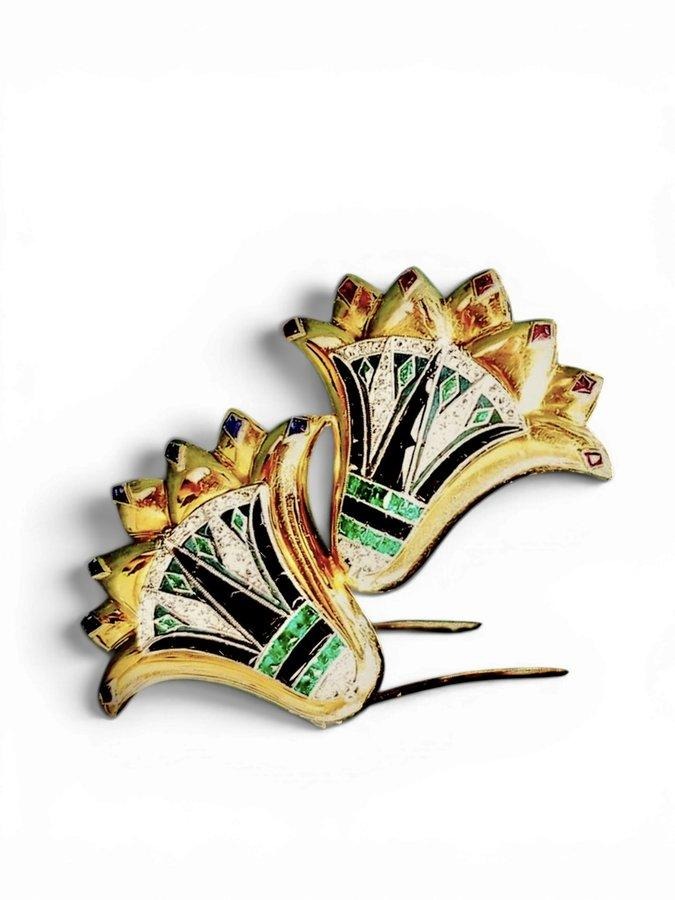
Double clip in enamelled gold depicting lotus flowers, set with diamonds, calibrated emeralds and coloured stones.
The motif appears in other materials as well: a double clip in white agate enhanced with diamonds, worn on the lapel of a suit and reproduced in Vogue in April 1936, and a pair of earrings in 22-carat gold set with rose-cut diamonds.
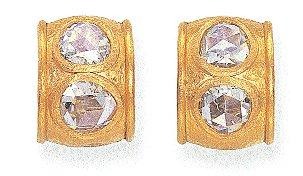
Pair of ear clips in hammered yellow gold, each set with rose-cut diamonds.
Crescent moon and scarab: the symbols
Several necklaces take the form of the crescent moon, a major symbol in Muslim countries: a Plastron necklace composed of the four precious stones cut as cabochons, and another bringing together a multitude of semi-precious stones in various sizes and cuts.
The scarab occupies a place apart. A symbol of resurrection in ancient Egypt, a blue ceramic scarab mounted as a ring in the Egyptian taste did belong to Suzanne Belperron's personal jewellery, a treasured souvenir of her journey. It appears, however, to have been absent from her ornamental repertoire. The distinction is telling: the designer could love wearing a motif without necessarily admitting it into her creative vocabulary.
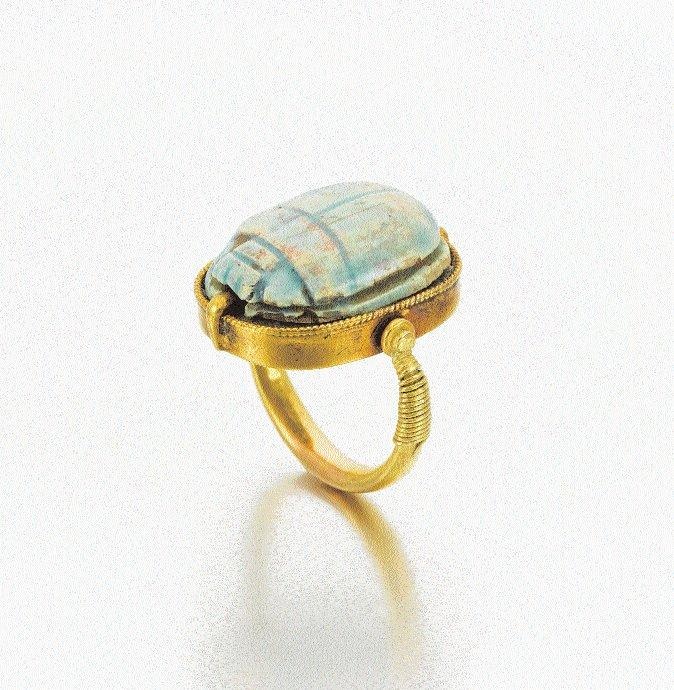
Antique yellow gold ring set with a blue ceramic scarab, a treasured souvenir of a journey to Egypt. Suzanne Belperron's own jewellery box, private collection.
Lapis lazuli, turquoise and gold: a palette from the Nile
Suzanne Belperron's most lasting borrowing from Egyptian art may not be formal at all, but chromatic. From Egypt she took combinations of stones that enriched her palette: lapis lazuli, turquoise and gold.
Lapis lazuli, described by Marco Polo as the finest azure in the world, holds a place of honour among the stones she used. The Egyptians, like the Mesopotamians, prized it so highly that they sought it as far as Afghanistan, in the deposits of Sar-e-Sang, as ornaments dated to around 3,200 BC attest. Suzanne Belperron used it abundantly: several necklaces bring together one or more rows of lapis lazuli beads, sometimes combined with jade or coral beads.
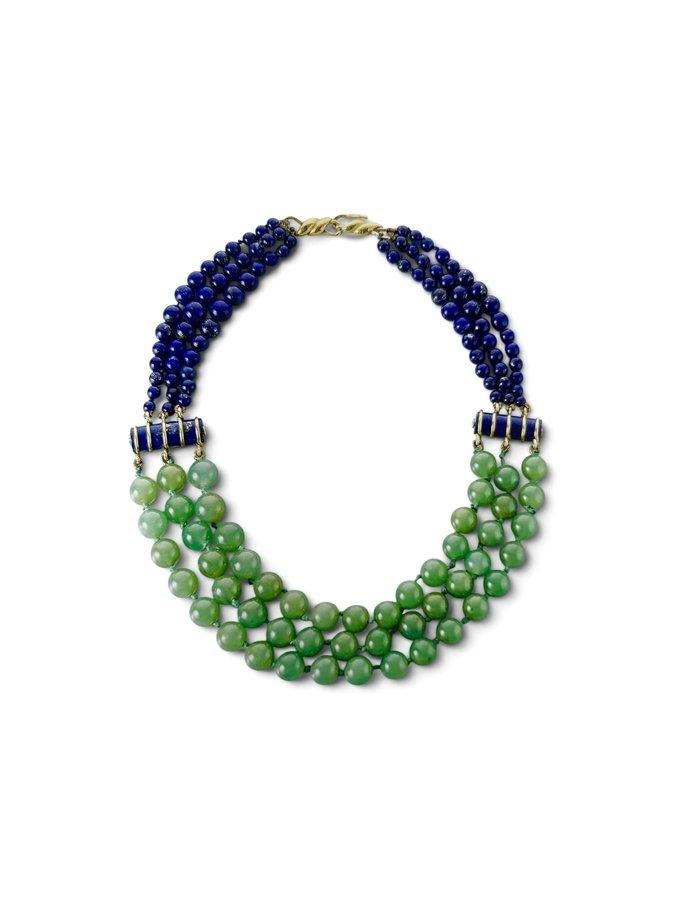
Necklace of jade and lapis lazuli beads, joined by two gold and lapis lazuli scroll motifs. Maker’s mark Darde et fils. Private collection.
Turquoise tells a similar story. Long before our era, the Egyptians were great admirers of the stone, extracting it from the deposits of Sinai to adorn most of their jewellery. The vogue for neo-Egyptian style pieces in the nineteenth and early twentieth centuries made it one of the stones most sought after by designers. Suzanne Belperron treated it in her own distinctive way, as in this necklace of hammered yellow gold set with seven substantial polished slices of baroque turquoise.
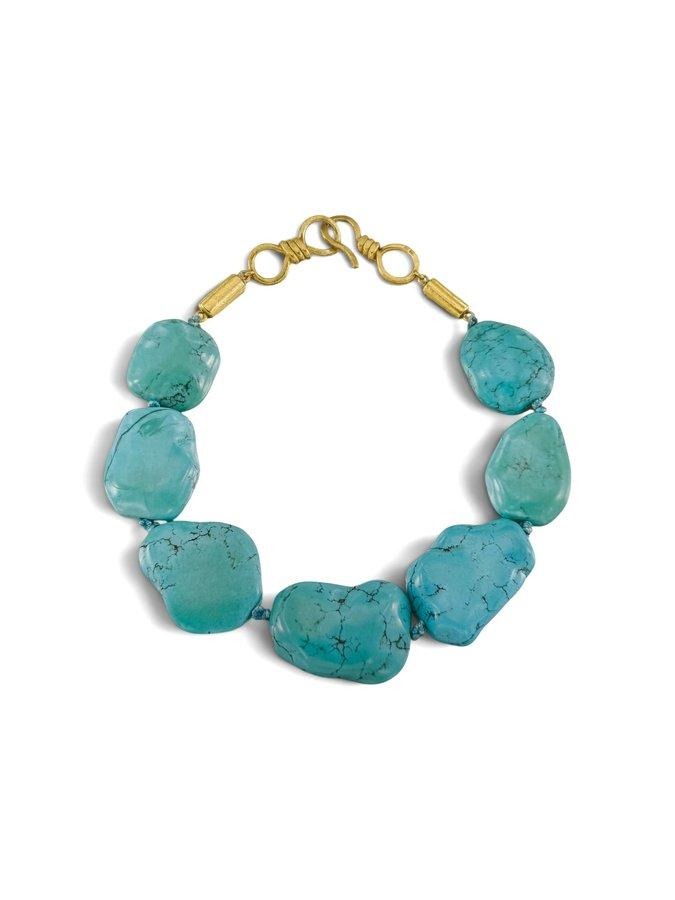
Necklace of baroque turquoises, with a rope-motif clasp in hammered yellow gold. Private collection.
Even peridot carries this memory: prized since antiquity, it was the object of Egyptian expeditions to the Red Sea and the island of Zabargad, whose name means olivine in Egyptian.
The archives, the only proof of these creations
As with agate, rock crystal or pearls, authenticating Suzanne Belperron's Egyptian-inspired creations runs up against a constant difficulty: these jewels bear no signature. Only the archives rediscovered in 2007 by Olivier Baroin make it possible to trace an original order and identify an authentic piece with certainty. The Giza photograph, the ledgers mentioning Lord Carnarvon and the 1944 correspondence are irreplaceable in this respect: they do not merely tell a story, they prove it.
An Egypt dreamed rather than quoted
Suzanne Belperron's Egypt is not the Egypt of pastiche. Where the Egyptomania of the 1920s multiplied sphinxes, hieroglyphs and pharaohs, she retained a geometry, a flower, a range of blues and gold. The 1923 journey produced no archaeological jewellery; it shaped a way of seeing. That may be the best definition of her modernity: turning an influence into a language of her own, rather than reproducing it.