Turquoise and Suzanne Belperron's Jewellery: From Sinai to Parisian Workshops
Turquoise and Suzanne Belperron's Jewellery: From Sinai to Parisian Workshops
Suzanne Belperron always knew how to distinguish stones with a rich historical past. Turquoise, revered for millennia by Egyptian, Aztec and Persian civilisations, found in her work a strikingly modern treatment. Between baroque necklaces, Bandeau rings and Boule rings, the designer explored every facet of this satin-blue gem.
Turquoise, a stone with a millennia-old past
A gem with azure reflections
Turquoise, with its satin appearance, evokes the blue that bears its name, or the azure blue. However, some collectors prefer it when it is streaked with irregular veins pepper or paprika in colour which give it a particular and unique appearance, earning it the name turquoise matrix.
From Egyptians to Aztecs
Long before our era, the Egyptians were great lovers of turquoises, extracted from the deposits of Sinai and prominently featured in most of their adornments. In Mexico, the Aztecs' taste for turquoise spread mainly between 900 and 1521 AD. The blue stone appears in magnificent ritual masks treated as mosaics, as well as in countless parures.
The arrival in the West
Appearing in the West in the 17th century, turquoises probably came from Turkish merchants who imported them from Persia hence their French name turquoise (meaning "Turkish"). The vogue in the 19th and early 20th centuries for neo-Egyptian style jewellery made it one of the sought-after stones among jewellery creators.
Suzanne Belperron's original treatment of turquoise
Suzanne Belperron liked to treat turquoise in an original way, in contrast to the classical settings of her time. Her boldness manifested itself in the choice of baroque stones, simply polished, far from the regular and calibrated stones favoured by the great Parisian houses.
The necklace with seven baroque turquoises
One of the most emblematic pieces is a hammered yellow gold necklace adorned with seven important polished baroque turquoise slices, with a rope-decorated clasp in hammered yellow gold (Darde et fils hallmark). This jewel, from the designer's personal collection, illustrates her predilection for irregular forms that celebrate raw materials.
The Bandeau ring in turquoise cabochons
A wide Bandeau ring in hammered yellow gold, set with marquise-cut turquoise cabochons, bears witness to Belperron's stylistic signature: the alliance of hammered gold with its almost raw reflections and the satin blue of turquoise creates a textural contrast of great elegance.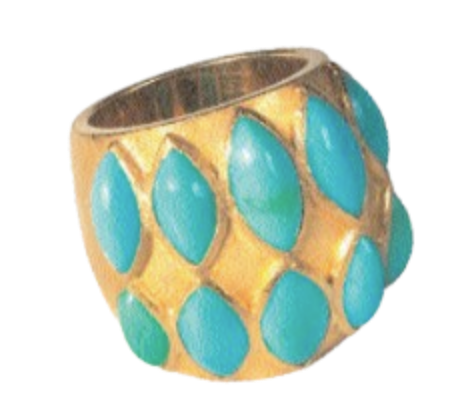
The Boule ring, a dialogue between turquoise and sapphire
A Boule ring in yellow gold, adorned with turquoise cabochons set in a honeycomb pattern and interspersed with a line of emerald-cut sapphires, illustrates Belperron's talent for marrying blues. This piece demonstrates her ability to create a dialogue between an opaque, satin stone and a transparent, brilliant gem.
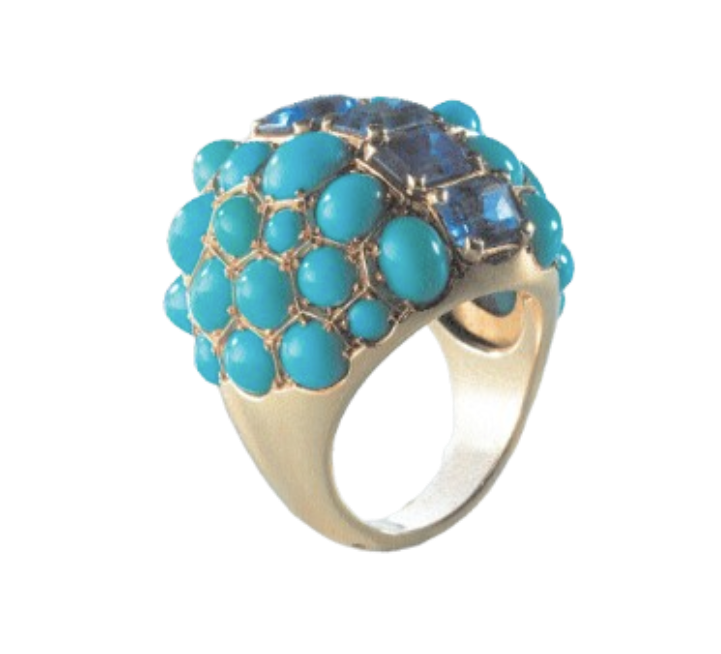 Boule ring in yellow gold, adorned with turquoise cabochons set in a honeycomb pattern, interspersed with a line of emerald-cut sapphires.
Cultural influences in turquoise creations
Egyptian inspiration
Suzanne Belperron borrowed from Egyptian art stone combinations that enriched her palette: lapis lazuli, turquoise and gold. These three materials, dear to the pharaohs, compose several of her creations with neo-Egyptian accents.
Himalayan and Indian inspiration
A peerless colourist, Belperron was enchanted by the multicoloured aspect of Indian parures. Among the jewels of her estate is a necklace composed of seven turquoises, the emblematic stone of Himalayan tribes. This Oriental inspiration, recurrent in her work, is also found in the combination of lapis lazuli and turquoise beads a blue-green note directly inspired by India.
A stone favoured by prestigious clientele
The Duke and Duchess of Windsor
From 1937 to 1972, the appointments of the Duke and Duchess of Windsor appeared regularly in Suzanne Belperron's notebooks. The couple, considered among the most elegant of their time, shared an unbridled passion for jewellery and assiduously frequented the rue de Châteaudun salons, alongside the great houses of Cartier and Van Cleef & Arpels.
Mrs Harrison Williams, future Countess of Bismarck
Famous for her elegance and frequently photographed for Vogue and Harper's Bazaar, Mrs Harrison Williams who would marry the Count of Bismarck after her husband's death was a regular client for important commissions. On 29 December 1951, Suzanne Belperron noted in her archives the receipt of an antique turquoise bracelet, five turquoise flowers, as well as a project for a second turquoise bracelet. For the turquoise necklace to be restrung, the designer specified: "remove the very green beads and replace the rock crystal discs" an attention to detail characteristic of her exacting standards.
Ganna Walska
The Russian-born opera singer Ganna Walska, a loyal client between 1937 and 1939 with sixty-five recorded appointments, notably commissioned a "turquoise and amethyst necklace", bearing witness to the enthusiasm of the artistic clientele for this stone.
The importance of archives for authentication
As with the other hard stones used by Suzanne Belperron, the authentication of turquoise jewellery relies on rigorous expertise work. Turquoise, a material that does not allow the application of a hallmark, makes it essential to refer to the archives rediscovered in 2007 by Olivier Baroin. Only these archives make it possible to trace the original order and to identify with certainty the authentic creations of the house.
A satin-blue heritage
By sublimating turquoise in her creations, Suzanne Belperron demonstrated that a millennia-old stone could be worn with absolute modernity. Her baroque necklaces, Bandeau rings and Boule rings continue to fascinate collectors and to traverse eras with timeless elegance. Turquoise, in her hands, ceases to be a mere exotic souvenir to become a fully contemporary stone.