Suzanne Belperron’s Sources of Inspiration
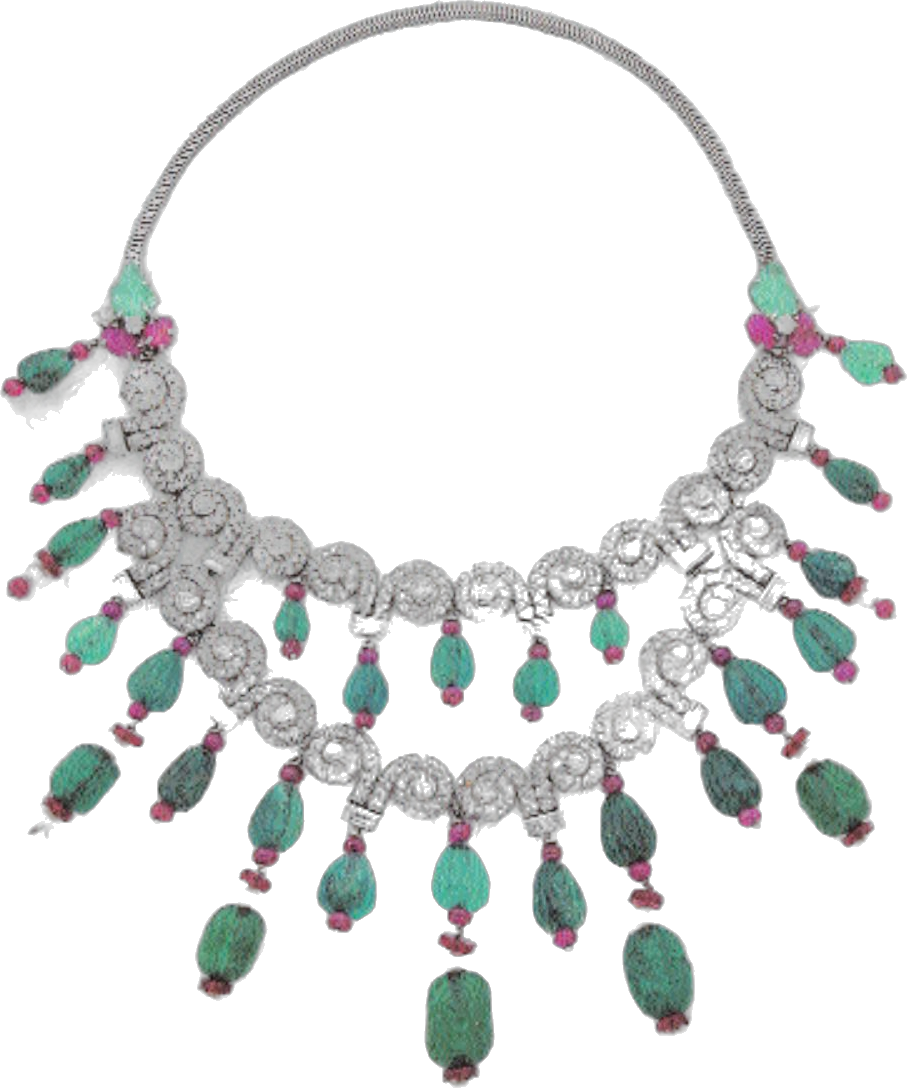
“Art Deco in the Indian taste” necklace in white gold, platinum, diamonds, emeralds and rubies: distant influences at the heart of Suzanne Belperron’s work. (Tajan)
The Sources of Inspiration of Suzanne Belperron
Multiple and kaleidoscopic, the sources of inspiration of Suzanne Belperron testify to an insatiable curiosity. From the most distant civilisations to the humblest forms of nature and the sea, the designer draws on an infinite repertoire to nourish an ever-renewed imagination. To understand these influences is to grasp the very essence of a body of work that revolutionised twentieth-century haute joaillerie.
An insatiable curiosity, at the heart of her work
The artistic expressions of distant and ancient civilisations, dating back to the most remote Antiquity, together with an observation of nature of acute sensitivity, fascinated and astonished Suzanne Belperron. Her extraordinary ability to play with aesthetic influences of every origin and with motifs inspired by nature lies at the very heart of her work.
Where other jewellers were content merely to quote a motif, she absorbed it, stripped it of all the picturesque and transposed it into stylised, pared-down lines. Far from mere copying, each borrowing became a pretext for formal reinvention. This method to purify, to stylise, to transpose runs through her entire oeuvre and sets her apart from her contemporaries.
Distant civilisations, an inexhaustible repertoire
The Orient, the Far East, Africa and Oceania fascinated the artists of the inter-war years. A keen reader and collector, Suzanne Belperron seized upon these worlds with a freedom all her own, transforming scholarly references into resolutely modern jewels.
Egypt and the return of “Egyptomania”
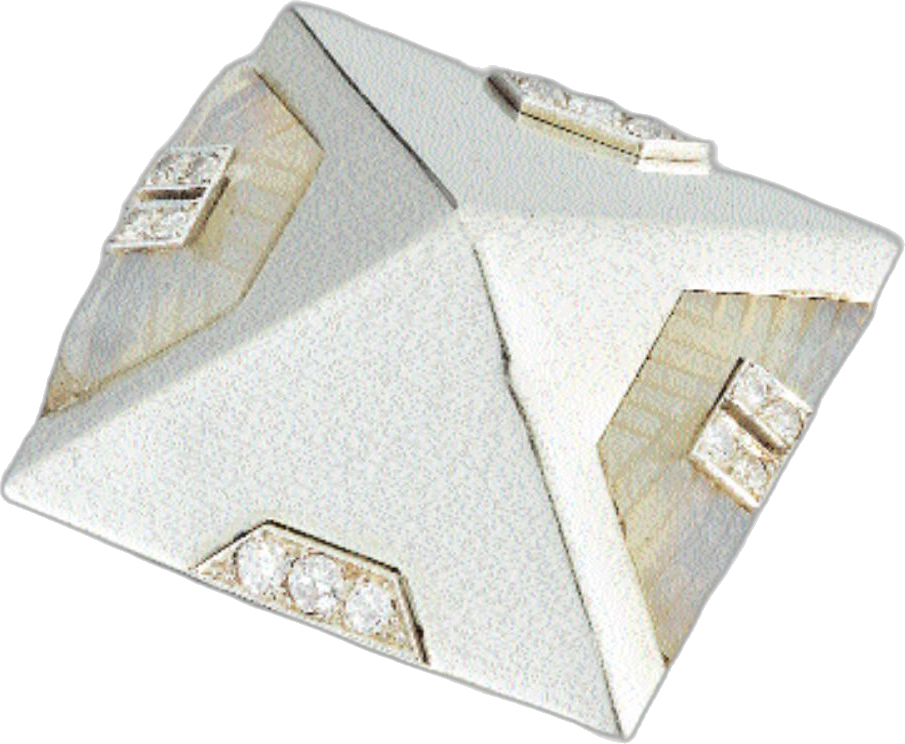
Pyramid brooch in platinum and white gold, set with white agate motifs punctuated by diamonds. (Private collection)
The West’s fascination with Egypt was nothing new: it dates back to Bonaparte’s Egyptian campaign in 1798 and to Vivant Denon’s publication of the Voyage dans la Basse et Haute-Égypte, a work that would become a major source of inspiration for the applied arts. But it was the discovery, in 1922, of Tutankhamun’s tomb by Howard Carter and Lord Carnarvon that revived “Egyptomania”, widely fuelled by the press.
Suzanne Belperron did not merely visit the Egyptian rooms of the Louvre: a photograph from her archives shows her on camelback before the pyramids of Giza, during a cruise undertaken in the autumn of 1923 on the occasion of her engagement to Jean Belperron. Remarkably, a letter dated 10 October 1944, preserved in her archives, reveals that she had designed, shortly before the war, jewellery projects for Lord Carnarvon the son of the Egyptologist whom she had met in Paris in 1940. Her Pyramid brooch, in carved white agate and diamonds, illustrates this source of inspiration reinterpreted with restraint.
Black Africa and the Maghreb
Leaf clip in yellow gold and platinum, underlined with a line of old-cut diamonds. (Aguttes)
At the beginning of the twentieth century, the passion for “art nègre” spread among young painters Vlaminck, Derain, Matisse, Picasso who collected masks and statuettes discovered at the ethnographic museum of the Trocadéro. The Colonial Exhibition of 1931, in the Bois de Vincennes, offered the wider public a spectacular panorama of it and inspired many jewellers.
For Suzanne Belperron, Africa became “an inexhaustible field of investigation, strange and fascinating”. Motifs of African vases, stylised tiger or panther claws, combinations of yellow gold, onyx and black enamel: the designer drew from it a renewed ornamental vocabulary, as evidenced by her play of gold volumes and her lines of old-cut diamonds.
India and the splendour of the maharajas
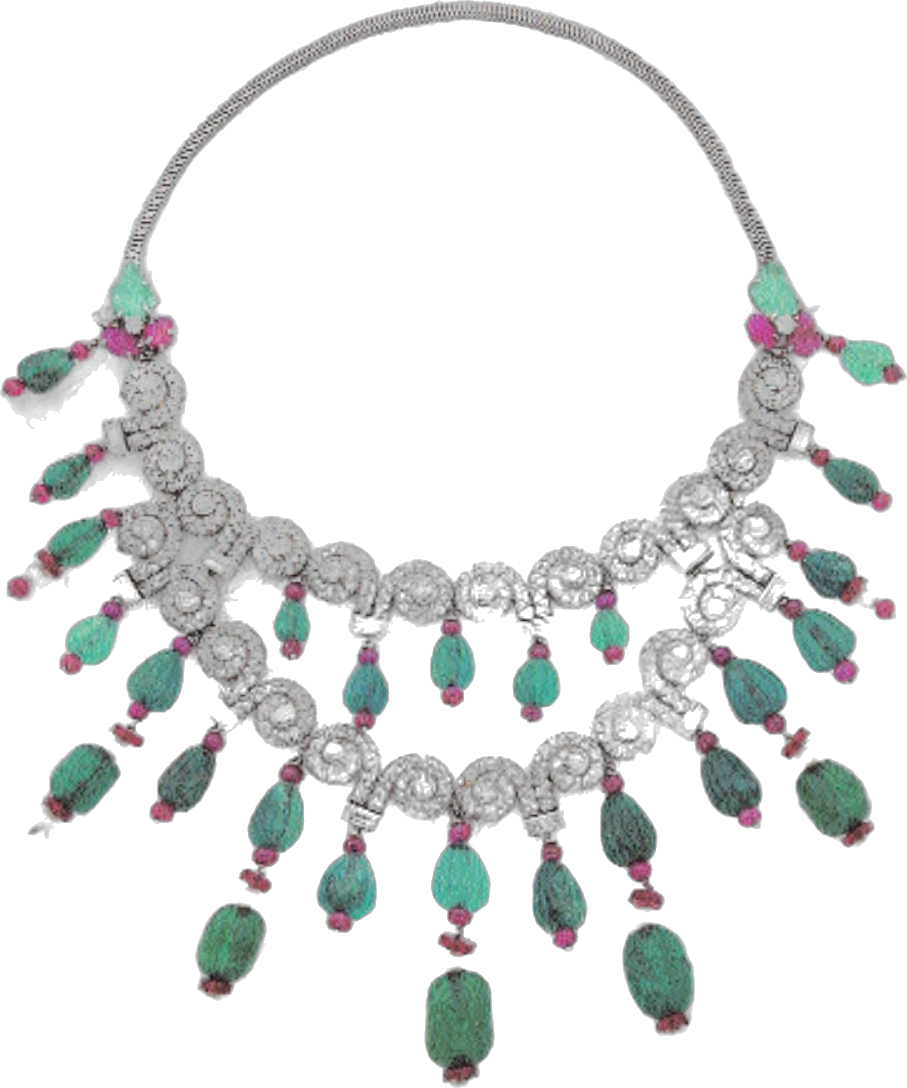
“Art Deco in the Indian taste” necklace in white gold, platinum, diamonds, emeralds and rubies. (Tajan)
In the 1910s and 1920s, Indian princes, won over by European creations, had their legendary parures transformed. The exhibition of the Maharaja of Patiala’s jewels, in 1928 on the Rue de la Paix, dazzled a press that saw in it a “treasure of the Thousand and One Nights”. This craze ran through all of Parisian jewellery.
Suzanne Belperron responded with plastron necklaces blending diamonds, sapphires, emeralds and engraved aquamarines, in an “Art Deco in the Indian taste” spirit. Some of these pieces, designed to be reconfigured into several jewels, reveal her taste for modularity and colour.
The Far East, from Japan to China
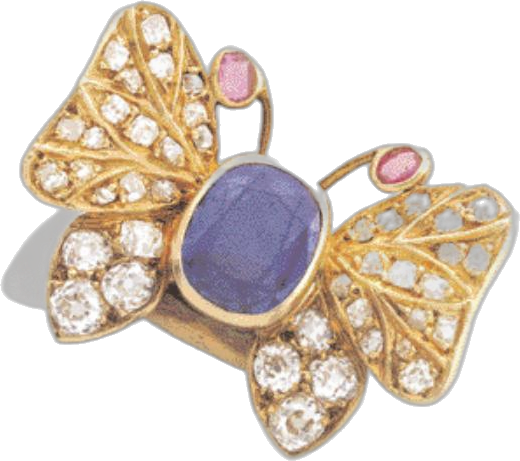
Butterfly earrings / brooch in yellow gold, set with sapphires and diamonds. (Private collection)
The opening of Japan during the Meiji era (1868-1912) revealed to Westerners a new art, popularised by the World’s Fairs and the boutiques of “japoneries”. The dealer Samuel Bing launched the monthly Le Japon artistique as early as 1888, distributed as far as London and New York. Suzanne Belperron owned works on the arts of the Far East in her library and collected Chinese snuff bottles.
From this source emerged a geometric, structured repertoire butterflies, snails, meander motifs in which Oriental rigour met her quest for purity. The Escargot (snail) necklace in yellow gold and brilliants, or her Butterfly brooches set with sapphires, are among its most refined expressions.
Nature, an inexhaustible and ever-present source
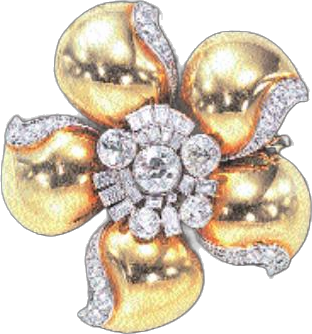
Flower brooch with yellow gold petals, platinum and diamonds, the centre enhanced with old-cut and baguette diamonds. (Christie’s)
“Ever-present in all civilisations”, nature was for Suzanne Belperron an inexhaustible source of inspiration. From the end of her studies at the Beaux-Arts, the sinuous lines of her sketchbooks were transposed into pared-down forms: stylised flowers, foliage, gadroons, fleshy petals.
A Flower brooch from her own collection, set with a diamond of about 8.5 carats in the Asscher cut, illustrates this learned stylisation in which nature is never imitated but reinvented. It is in this same spirit that she declined her favourite stones, from polished or frosted rock crystal to white, blond or banded agate.
The sea and shells, an aesthetic guiding thread
While the marine world runs through her entire oeuvre, it is the fascination with shells that constitutes its true guiding thread. Helical shells, spirals, starfish, sea urchins: these forms allowed her to take up one of her major ambitions to set matter in motion.
The Sea Urchin bracelet, photographed for Vogue in February 1936, or the Nautilus clips in rock crystal worn by Elsa Schiaparelli, bear witness to this inventiveness. This marine imagination is found in her taste for gems evoking water, such as aquamarine, cut into spectacular blocks, or pearls, of marine origin.
A unique stylistic grammar
Whatever the source an Egyptian scarab, an African mask, a starfish or even a simple paperclip glimpsed in her archives Suzanne Belperron applied the same method: to purify, to stylise, to transpose from one type of jewel to another. This coherent grammar, legible from a ring to a bracelet, makes her one of the most singular designers of her century.
Authenticating the creations through the archives
Many of these jewels, carved from hardstones that cannot bear a hallmark, carry no signature. Only the archives rediscovered in 2007 by Olivier Baroin make it possible to identify the authentic pieces with certainty and to trace their original commissions, thanks to the preserved original gouaches and plaster casts. This documentary work is today essential to the expertise of the market.
An imagination in the service of modernity
By absorbing Egypt, Africa, India, the Far East, nature and the sea into a single pared-down language, Suzanne Belperron made the diversity of her sources the very material of an absolute modernity. Each of these themes will be the subject of a dedicated article; to explore her world further, discover the page devoted to Suzanne Belperron or browse all our articles from the homepage.