Nature in the Work of Suzanne Belperron: Flowers, Leaves and Grapes
Flowers, Leaves and Grapes: Suzanne Belperron and Nature
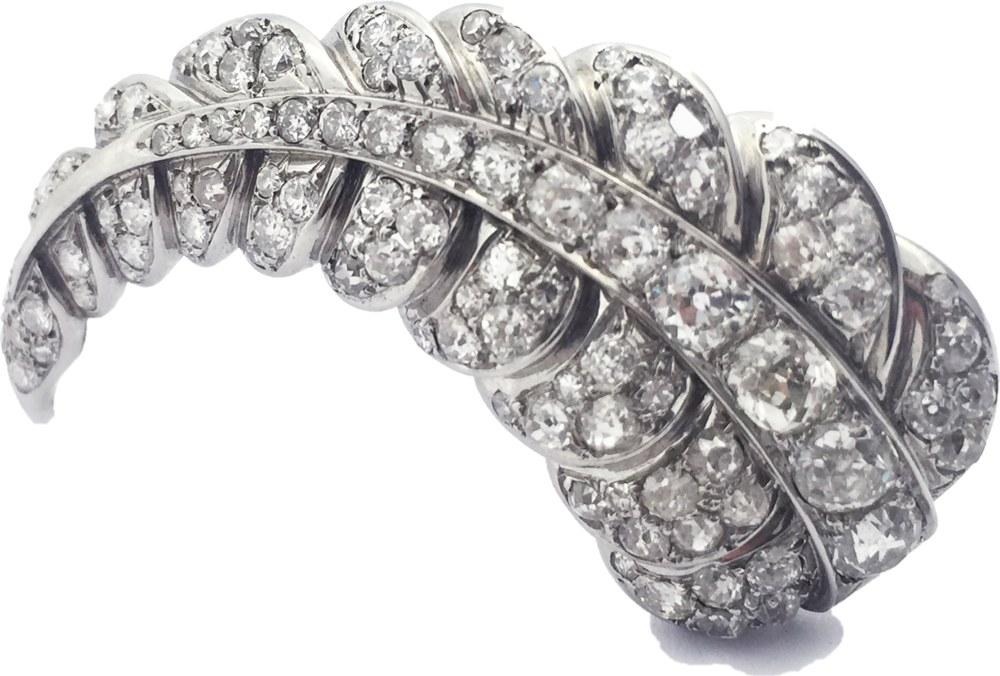
Plume clip in platinum, shaped as a twisted leaf paved with old-cut diamonds.
Of all the sources of inspiration of Suzanne Belperron, nature is the most constant. Flowers, leaves, grapes, ferns and fir trees run through her entire career, from the 1930s to the 1950s. Yet the designer never copies: she stylises, she pares down, she turns a leaf into a volume and a grape cluster into a sculpture. This article continues our series on her sources of inspiration.
Key takeaways
• Nature is a universal motif in jewellery, brought back to the fore by Art Nouveau at the turn of the twentieth century.
• Suzanne Belperron turned the sinuous lines of her study notebooks into pared-down lines as soon as she left art school.
• From 1932, her Herz-Belperron jewels anticipated the great return of the figurative style, which triumphed at the 1937 Exhibition.
• Her signature motifs: the grape cluster, the leaf, the Christmas tree, the fern, the ear of wheat and the camellia.
A universal source, from Ruskin to Art Nouveau
Present in every civilisation, however remote, nature is an inexhaustible and permanent source of inspiration for jewellery: there is no people, however modest in material terms, that does not include it in its ornamental repertoire.
In Europe, a genuine passion for horticulture emerged in the early nineteenth century. Expeditions set off for the Far East and the Americas in search of exotic species, which often became models for jewellers. In the middle of the century, several illustrated works theorised the use of plants as motifs: John Ruskin stressed the value of taking nature as the basis of decorative design, and Owen Jones, in his famous Grammar of Ornament (1856), suggested ways of bringing plants into the ornamental repertoire.
From art school notebooks to the pared-down line
Art Nouveau, whose brief life in jewellery spans 1895 to 1920, also drew on nature. Its meandering lines appear in the study notebooks of the young Suzanne Vuillerme. But as soon as she finished her studies at the School of Fine Arts, these curves were transposed into stylised, pared-down lines: the flower became geometry, as in this brooch where an Asscher-cut diamond of about 8.5 carats crowns a corolla of round stones. An approach that echoes the lesson of Japanese art discussed in our article on the Far East.
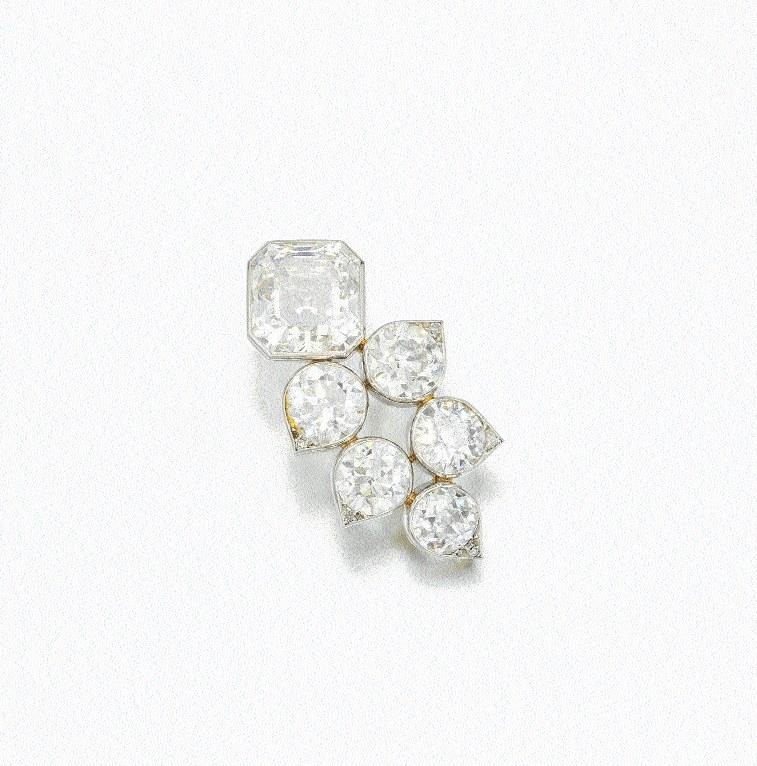
Stylised Flower brooch in white gold and platinum, set with diamonds including an Asscher-cut stone of about 8.5 carats. Groëné et Darde maker’s mark. Suzanne Belperron’s own jewellery box, private collection.
-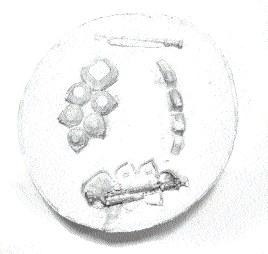
Original plaster cast of the Flower brooch. Olivier Baroin Archives.
1937: the triumph of the figurative style
The geometric aesthetic of the 1920s, kept alive for a while by a few nostalgic designers, faded in the early 1930s. The shift accelerated as the Second World War approached and secured the triumph of the figurative style inspired by nature. Designers allowed themselves every fantasy, and for some twenty years an extraordinary variety of models won public favour.
This outpouring found expression in Paris at the 1937 International Exhibition of Arts and Technology. The admissions committee, chaired by the jeweller Georges Fouquet, intended to reject projects “scrupulously copying nature”, yet it often found itself facing designs that betrayed “too marked a tendency to use barely transposed floral decoration”.
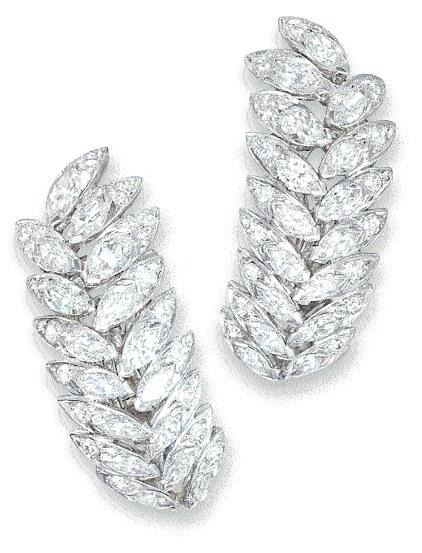
Pair of ear clips in platinum and white gold shaped as stylised ears of wheat, set with diamonds. Groëné et Darde maker’s mark. Pierre Bergé & associés.
Herz-Belperron, one step ahead
The Herz-Belperron jewels, of which she was the sole designer from April 1932, reproduced in the early 1930s in fashion magazines, suggest that Suzanne Belperron had anticipated this return of nature. Her talent and her tireless taste for the plant world built her reputation, and the profusion of her models defies any inventory.
The grape cluster, a classic in endless variations
A timeless classic, the Grape cluster clip lends itself to endless variations: grapes in chalcedony each set with a pearl and held by a bar of brilliant-cut diamonds, a rock crystal version set with sapphires in shades of blue, or a parure in white agate paired with grey pearls and set in white gold. The archives keep the sketch, the gouache and the original plaster cast, which show the work on volume before manufacture.
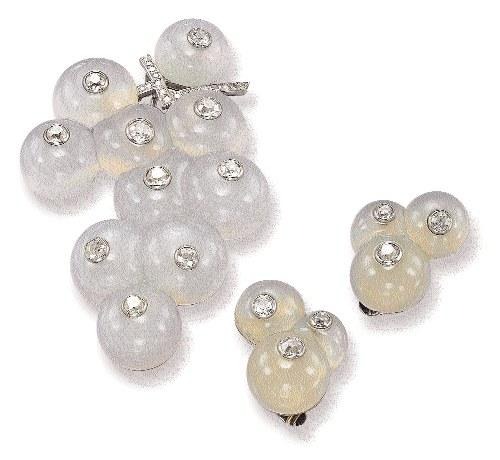
Grape cluster brooch and Grape earrings in chalcedony enhanced with diamonds. Groëné et Darde maker’s mark. Sotheby’s.
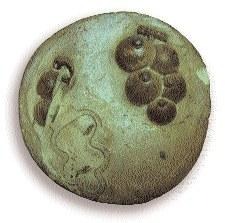
Original plaster cast of a Grape cluster clip. Olivier Baroin Archives.
The Christmas tree, between jewel and private memory
A stylised Christmas tree double clip is set with old-cut diamonds. The motif touches on the personal: one of the private photographs kept in her archives shows a decorated Christmas tree in the drawing room of her apartment. On her brooches, the tree becomes an architecture of diamonds, geometric or dotted with baubles.
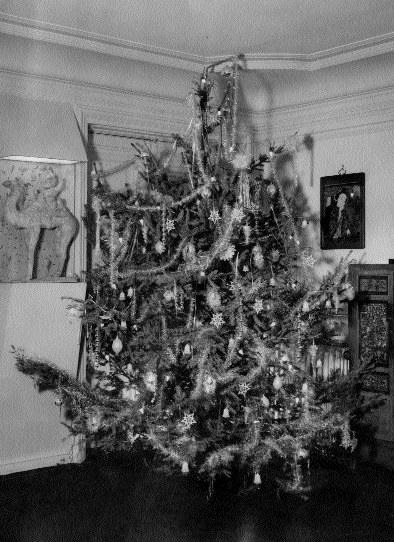
Christmas tree in Suzanne Belperron’s apartment. Olivier Baroin Archives.
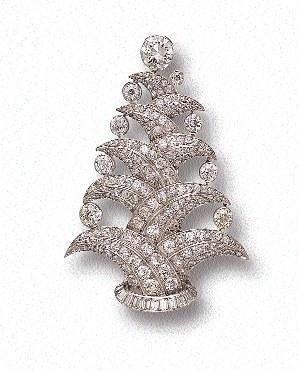
Stylised Christmas tree brooch with baubles, set with diamonds and a line of baguettes on platinum and white gold. Groëné et Darde maker’s mark. Sotheby’s.
The leaf, her favourite motif
A great favourite of her repertoire, the leaf lends itself endlessly to variations in size, shape and material. It appears on every kind of jewel: earrings, clips, brooches, necklaces and bracelets. Leaves of platinum and diamonds wrap voluptuously around the wrist, and a sumptuous double clip shaped as a twisted leaf, enhanced with lines of brilliant-cut diamonds, featured in a Herz-Belperron advertisement in Vogue in December 1950. There is also a Honesty (Monnaie du pape) clip in yellow gold and diamonds.
The Plume clip shown at the top of this article is a perfect example. Her archives keep its written record: the page of the order ledger where the jewel appears, with the handwritten note and the period photograph, makes it possible to date and authenticate it with certainty.
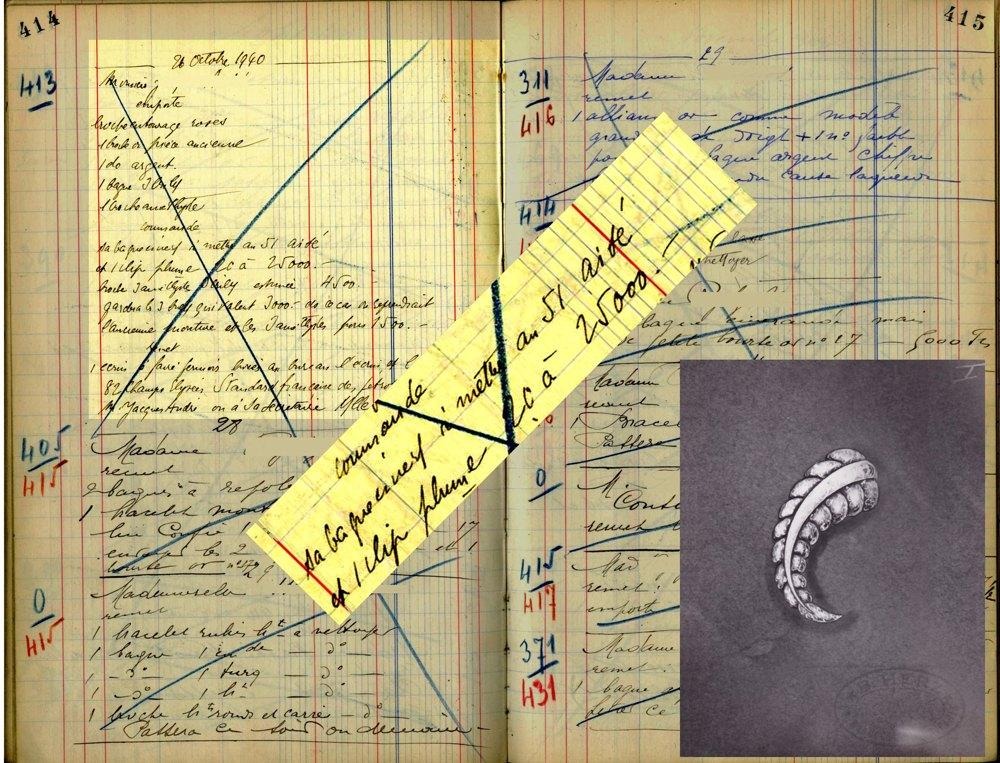
The house order ledger, with the entry for the Plume clip and its period photograph. Olivier Baroin Archives.
The fern inspired a bracelet, photographed in Vogue in August 1936, which can also be worn as a tiara: its fronds form a series of scrolls, the two largest at the centre and the others graduated on each side.
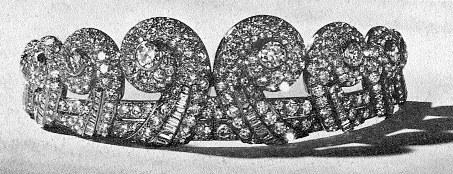
Fern bracelet in platinum and diamonds, convertible into a tiara. Photo by André Durst, French Vogue, August 1936. Olivier Baroin Archives.
Pansy, edelweiss and camellia
Flowers are rendered in unexpected materials. Two pansies in blue, violet, brown and yellow stones form a brooch. The edelweiss, the lucky flower of the high mountains, becomes a clip with white agate petals centred on a diamond. A camellia with chalcedony petals, a heart of brilliant-cut diamonds and emerald leaves can be mounted on a rigid black lacquered metal link to be worn as a necklace.
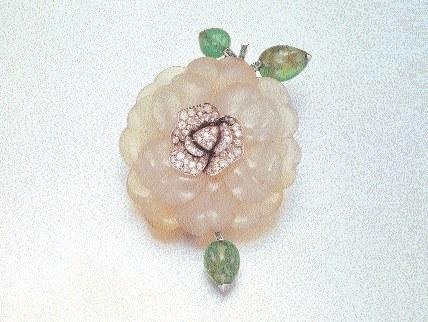
Camellia brooch on white gold, chalcedony petals, old-cut diamond centre and emerald leaves, convertible into a necklace (French Vogue, December 1950). Sotheby’s.
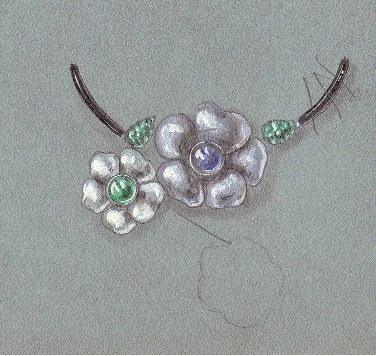
Gouache, design for a Lien necklace with rock crystal flowers set with cabochon sapphire and emerald, held by a black enamelled metal link. Olivier Baroin Archives.
Nature stylised, never copied
What sets Suzanne Belperron apart from the floral wave of the 1930s is precisely what the 1937 committee feared: she does not copy nature, she transposes it. The grape cluster becomes a chalcedony sculpture, the leaf a volume, the fir tree an architecture of diamonds. As with all her work, her jewels are unsigned: only the archives rediscovered by Olivier Baroin (gouaches, plaster casts, ledgers) make it possible today to authenticate these pieces.