The Far East in the Work of Suzanne Belperron: from Japonisme to Intimate China
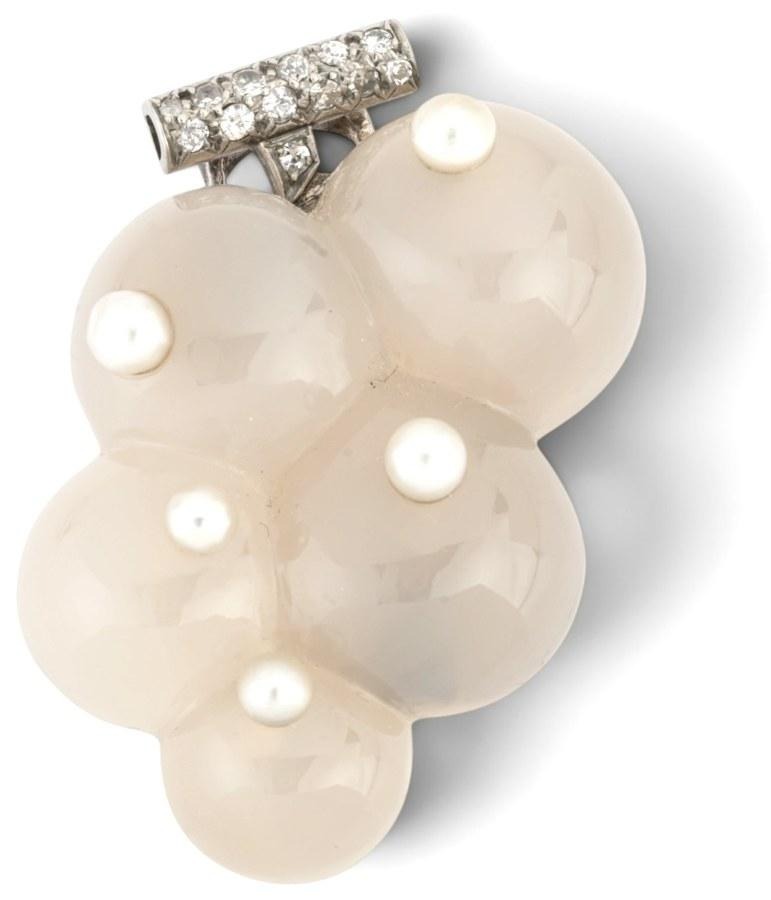
Chalcedony pendant with cloud-like volumes, set with pearls, the bail set with diamonds.
To close the “Themes and Influences” series, after Egypt, Africa and India, here is the deepest influence of all. For Suzanne Belperron, Japan and China were not one more exotic backdrop: they lie at the very root of her style. From Japanese art she drew, as early as her student years, a lesson that would govern her entire work, the idea that nothing in nature is unworthy of becoming a jewel.
Key takeaways
• From 1915 to 1918, at the Besançon School of Fine Arts, Suzanne Belperron copied Japanese motifs and plates from Hokusai’s Manga.
• Japanese art, combined with Art Nouveau, fed the pared-down, geometric and structured style she developed in the Art Deco era.
• Cloud, spiral, butterfly, fan: her motifs, like her palette (black lacquer, coral, jade, chalcedony), came from the Far East.
• China also shaped her private life: kimonos, a mandarin coat, Ming lacquer and Chinese snuff bottles.
Japonisme, a wave from the nineteenth century
In the second half of the nineteenth century, Japan became a major source of motifs for the West. In 1868, the end of the long isolation of the Tokugawa shogunate opened the country to the world, ushering in the Meiji era (1868-1912). The Japanese pavilions at the World Fairs drew crowds, while shops selling “chinoiseries-japoneries” multiplied in Paris.
The dealer Samuel Bing, one of the most respected of his day, opened a shop of Far Eastern objects in 1871, travelled to China and Japan in 1875, then launched in 1888 a monthly review, Le Japon artistique, published in French, English and German. The opening of the Musée Guimet in Paris in 1889, with the works brought back from China and Japan by Émile Guimet, firmly established this aesthetic at the heart of Parisian artistic life.
Hokusai and the Besançon notebooks: nature as sole mistress
In his introduction to Le Japon artistique, Samuel Bing summed up the lesson of Japanese art: the Japanese artist is convinced that all essential elements are found in nature, and that nothing, not even a blade of grass, is unworthy of a place in the highest conceptions of art. This age-old and fundamental belief runs through the whole of Suzanne Belperron’s work, which would continually borrow forms and motifs from the Far East, rendered faithfully or stylised.
Her archives hold the most moving proof. The notebooks she filled at the Besançon School of Fine Arts, when she was still Suzanne Vuillerme, already reveal her keen interest in Japanese art: a page of ideograms, a dappled cloud (kumo) common to Chinese and Japanese iconography, the “three friends of winter” (pine, bamboo and plum blossom, symbols of longevity) and several drawings taken from the fifteen-volume Manga of Hokusai.
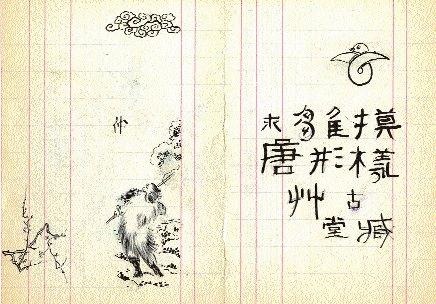
Indian ink drawings made at the Besançon School of Fine Arts, Suzanne Belperron’s study notebooks, 1915-1918. Olivier Baroin Archives.
Figures from Japanese folklore also appear: Okame, goddess of mirth, whose dance lured the sun goddess Amaterasu out of her cave; Fukusuke, the good-luck figure displayed by shopkeepers; and the kabuki actor Ichikawa Danjûrô, recognisable by the ornamental pattern of his kimono.
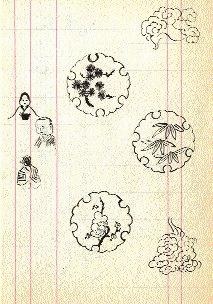
Notebook page: circular motifs of the “three friends of winter”, clouds and figures after Hokusai, 1915-1918. Olivier Baroin Archives.
From Art Nouveau to Art Deco: the Far East as the source of her style
Hokusai (1760-1849), known as the “old man mad about painting”, depicted plants, animals, landscapes, children’s games and a thousand scenes of daily life. This early initiation awakened in the young woman an interest in an unfamiliar aesthetic language that she would never cease to explore.
From it was born the style that would become her own. True to her conviction about the beauty of forms, Suzanne Belperron created an alchemy between what she was taught, Art Nouveau, and the spirit of the times, as the day was dawning on Art Deco, pared-down, geometric and structured. The Far East was therefore not one theme among others for her: it was the ground of her modernity.
Cloud, spiral, butterfly, fan: the Japanese motifs of her jewels
The cloud and the spiral
The dappled cloud and the spiral, recurring motifs of Japanese art, became in her hands full, sensual scrolls. The Escargot necklace in yellow gold and brilliant-cut diamonds is their culmination: its original plaster cast, kept in the archives, shows the search for volume before manufacture. The clips with scroll decoration pursue the same writing.
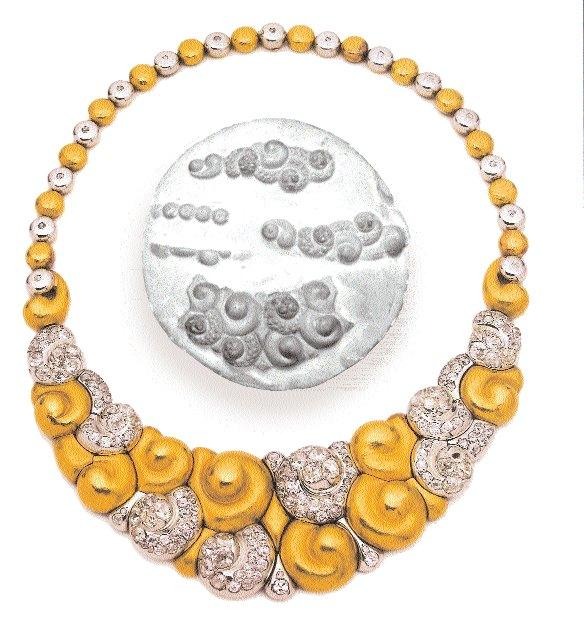
Escargot necklace in yellow gold and brilliant-cut diamonds on platinum (Pierre Bergé & associés) and its original plaster cast (Olivier Baroin Archives).
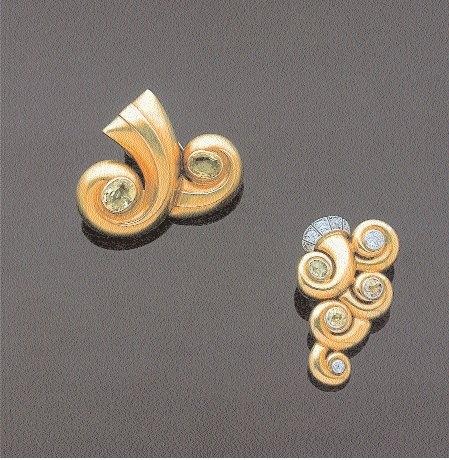
Yellow gold clip set with two yellow sapphires, and scroll clip in yellow gold with yellow and white diamonds. Pierre Bergé & associés.
The butterfly, the fan and the swan
Fauna and everyday Japanese objects inspired other forms: Butterfly earrings and brooches, Fan ear clips in diamonds, and a stylised Swan brooch in platinum whose double bangle allows it to be worn as a bracelet, proof of her taste for convertible jewels.
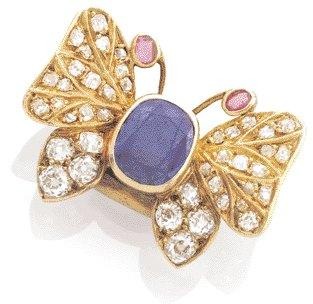
Butterfly earring in yellow gold set with blue sapphires, pink sapphires and diamonds. Private collection.
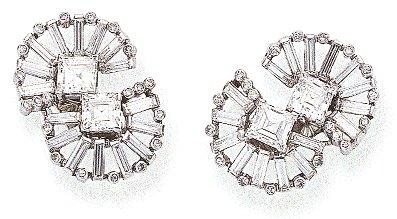
Pair of Fan ear clips in white gold and platinum, square-cut, baguette and brilliant-cut diamonds. Christie’s.
A diaphanous palette: pearls, chalcedony, jade and rock crystal
The Far East also inspired in Suzanne Belperron a colour, or rather an absence of colour. In contrast to her polychrome pieces, a whole family of jewels plays on chromatic evanescence, in diaphanous tones: combinations of pearls, white agates, chalcedonies, moonstones, rock crystal and pale green jade. A softness of celadon porcelain that owes everything to the art of China and Japan. The chalcedony and pearl pendant shown at the top of this article is the most telling example: its bubble-like volumes recall the dappled cloud of her early notebooks.
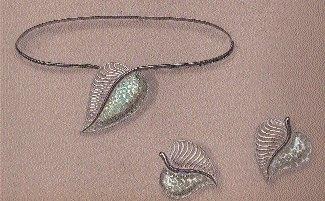
Gouache, design for a Lien necklace in lacquered metal, with a white gold leaf openworked on one side and paved with aquamarines on the other, and matching clips. Olivier Baroin Archives.
Jade holds a special place. Revered by the Chinese, who credited it with the power of immortality (under the Han dynasty, the dead were buried in suits of jade plaques), it directly inspired her jewels: the late Ming flower-shaped jade hair ornaments gave rise to her Flower brooches, made in smoky quartz inlaid with cabochon emeralds or in amethyst with a heart of ruby, sapphire and diamond.
Lacquer, coral and gold: the colours of China
At the other end of her palette, the Far East offered bold contrasts: the deep black of lacquer, the red of coral, the glow of gold. Her workshop gouaches bear witness to this, such as this design for a parure in coral and partly enamelled gold, or this twisted necklace in yellow gold lacquered black and dotted with emerald beads.
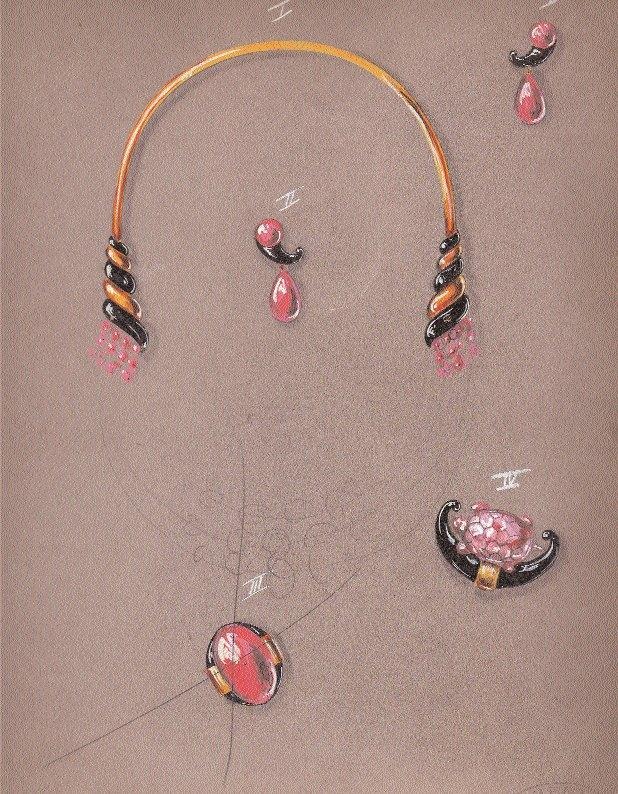
Gouache, design for a parure (half-choker, earrings, brooch and ring) in coral and partly enamelled gold. Olivier Baroin Archives.
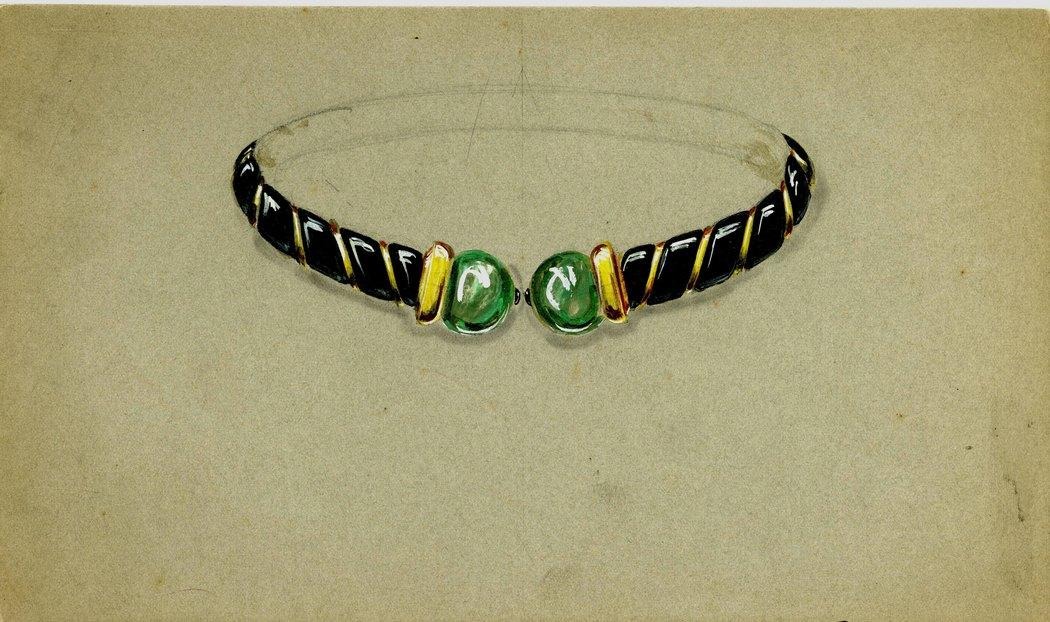
Gouache, design for a twisted necklace in yellow gold lacquered black, dotted with emerald beads. Olivier Baroin Archives.
Intimate China: wardrobe, décor and snuff bottles
Suzanne Belperron’s fascination with the East went beyond jewellery and pervaded her daily life. It was in keeping with the spirit of the times: Poiret launched his Nuit de Chine perfume before the Great War, Elizabeth Arden presented Ming in a lacquer bottle in 1925, Guerlain created Liu in 1929, and the collections of Molyneux, Mainbocher and Lucien Lelong (the Confucius model, 1927-1928) drew on China. One photograph shows her on her balcony in a mandarin coat, another in her drawing room in a kimono jacket with floral motifs.
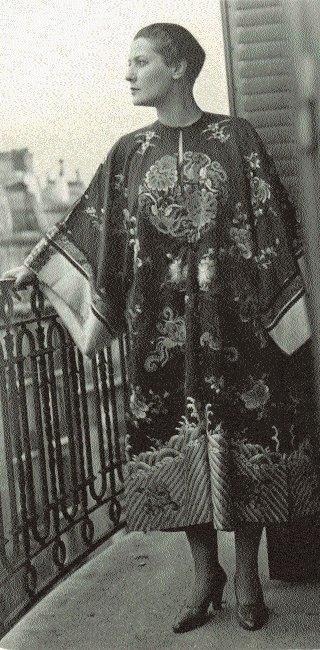
Suzanne Belperron on her balcony, wearing an embroidered silk kimono. Olivier Baroin Archives.
The eclectic décor of her apartment, designed with her friend the decorator Marcel Coard, is even more revealing. Its charm lies in the unexpected pairing of Western and Far Eastern pieces: a Ming dynasty rammed-earth head, a Ming-style red lacquer cabinet, Chinese travel trunks in red lacquered leather, a Song-style crackled celadon bowl, black lacquer panels remounted as a coffee table, a Siamese chariot wood displayed as a sculpture, and a collection of Chinese snuff bottles.
These objects in turn became jewels. This design for a pendant in the form of a flask, in red tourmaline or red lacquer, holding a tassel of gold chains, transposes almost literally the silhouette of the snuff bottles she collected.
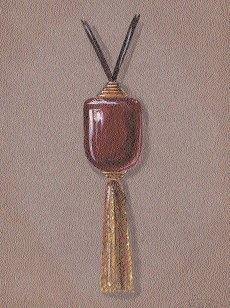
Gouache, design for a pendant in red tourmaline or red lacquer shaped as a flask, holding a tassel of yellow gold chains. Olivier Baroin Archives.
A lesson in restraint
Where India had given her a grammar of colour and Africa a workshop gesture, the Far East gave her more: a philosophy of form. Nature reduced to its essence, the pure line, the right volume: this Japanese lesson underpins her vocabulary. Like all her creations, Suzanne Belperron’s jewels are unsigned: only the archives rediscovered by Olivier Baroin make it possible today to identify and authenticate these pieces.