India in the Work of Suzanne Belperron
India in the Work of Suzanne Belperron
Of all the distant influences that run through the work of Suzanne Belperron, India is surely the most fertile. After Egypt and Africa, this new article in the “Themes and Influences” series explores a twofold relationship, that of a designer who wished both to steep herself in the Indian jewellery tradition and to reinvent it. The boteh motif, the turban form, the maharajas' rough emeralds, the peacock palette: India offered her an entire vocabulary, which she made her own.
The India of the maharajas, a fascination of the Roaring Twenties
A few links had formed as early as the nineteenth century between maharajas and European jewellers, but it was in the 1910s and 1920s that Indian princes, won over by Parisian creations, decided to have their legendary parures transformed. In the 1920s, the salons of the Place Vendôme and the Rue de la Paix saw maharajas file through, escorted by bearers carrying caskets full of pearls and unmounted stones.
One commission struck the public imagination: Cartier's transformation of the crown jewels of the Maharaja of Patiala in the Art Deco style, yet in keeping with India's traditional forms. The maharaja also entrusted Boucheron with six caskets holding the most sumptuous set of emeralds imaginable, 1,800 carats. Exhibited in 1928 on the Rue de la Paix, these treasures out of the Thousand and One Nights were widely reported by a dazzled press.
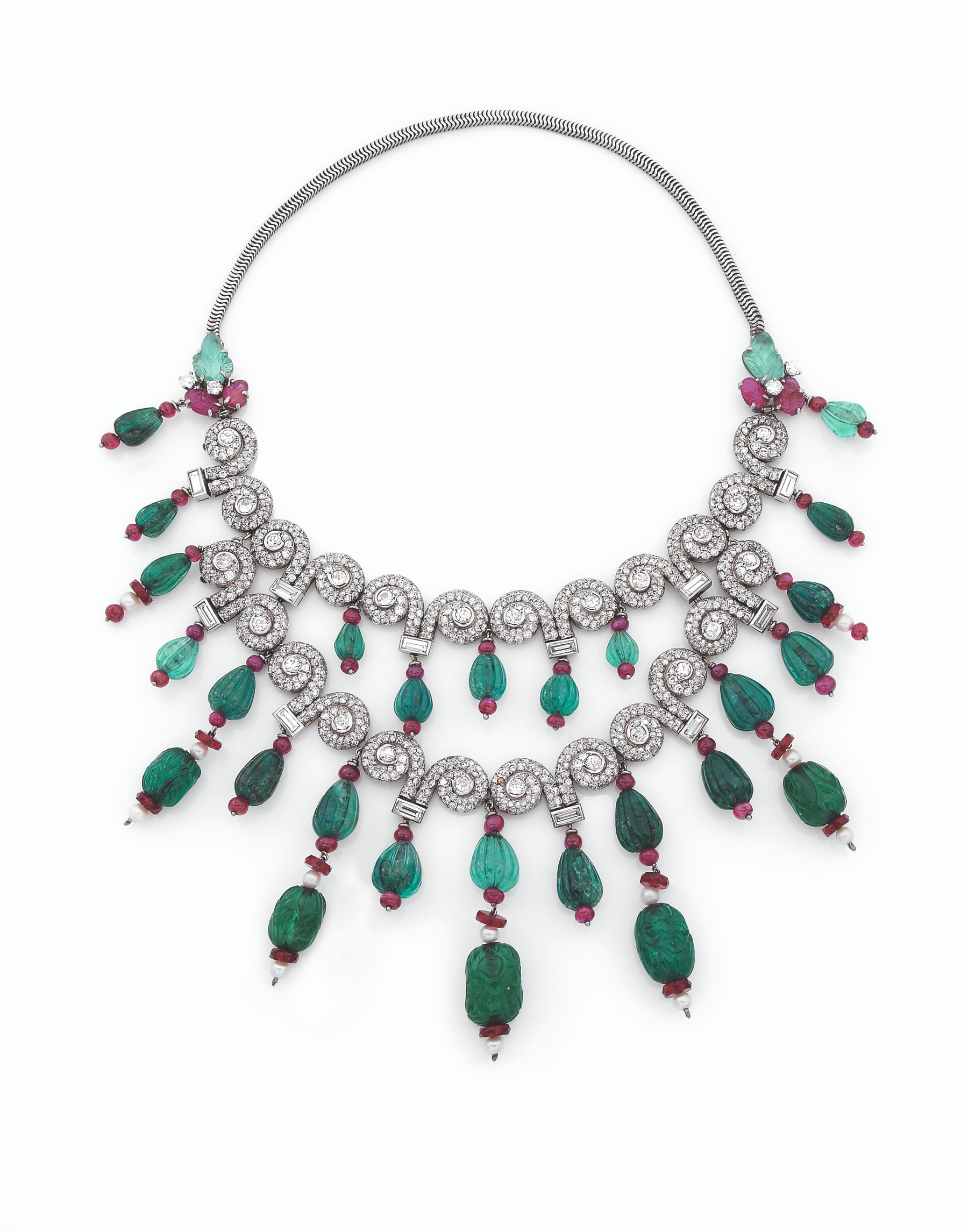
Necklace “Art Deco in the Indian taste” in white gold, platinum, diamonds, emeralds and rubies, originally convertible into several compositions.
1935: Vogue, Schiaparelli and the sari
Europe's enthusiasm for India peaked in the 1930s. In April 1935, Vogue published a long article entitled “Elegance in India.” That same year, Elsa Schiaparelli, a loyal friend of Suzanne Belperron, presented a collection of evening gowns in draped fabrics that wrapped the body, literally inspired by the sari.
Shortly afterwards, at an unforgettable costume party given by Daisy Fellowes, whose gardens were transformed into an oriental paradise with palm trees, orchids, scented fountains and even a statue of the Buddha, Schiaparelli appeared adorned with Suzanne Belperron's jewels. It was in this Paris enthralled by India that the designer drew motifs, forms and unexpected combinations of stones.
A twofold project: exploring and “Europeanising” the tradition
Suzanne Belperron's relationship with India was twofold: to explore the Indian jewellery tradition and absorb it into her art, and at the same time to “Europeanise” that tradition. She did not copy the maharajas' parures; she drew from them a grammar, forms and a way of handling colour, which she recast into her own language.
The boteh motif, borrowed from Mughal art
Indian jewels often draw on nature, treated in a naturalistic or stylised manner, derived from flowers, seeds and fruit. Suzanne Belperron's preferences led her to a motif widespread in India: the cone-shaped leaf with a bent tip, or boteh, a favourite ornament of Mughal art, seen on the borders of miniatures, on Persian carpets and on Kashmir shawls. Her appropriation of this stylised motif recurs throughout her work, and shows how she renewed her decorative repertoire.
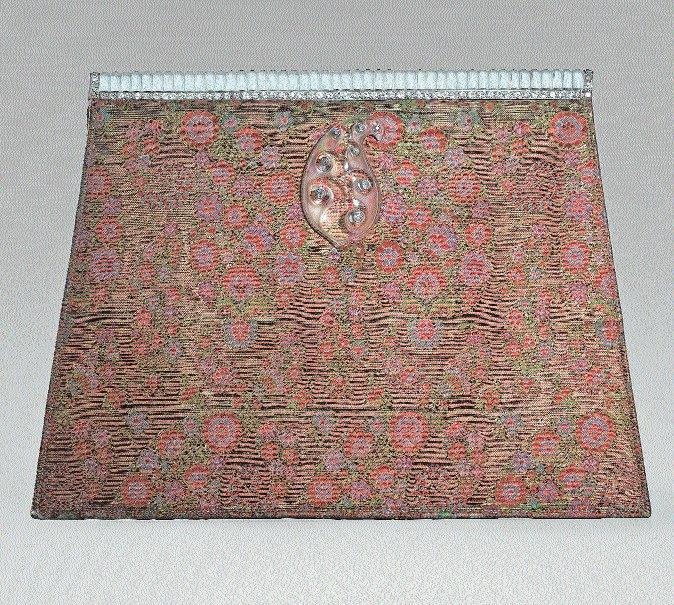
Clutch in Indian brocade, the clasp in the form of a boteh set with diamonds.
The turban, source of rings and brooches
The Indian turban inspired her designs for rings and brooches in gold and in hardstones set with pearls or gems. This form, which she had sketched in her notebooks since adolescence, appealed to her because it gave matter the illusion of movement, a cardinal feature of her work. In hammered gold or polished stone, these full, rounded volumes became one of her signatures.
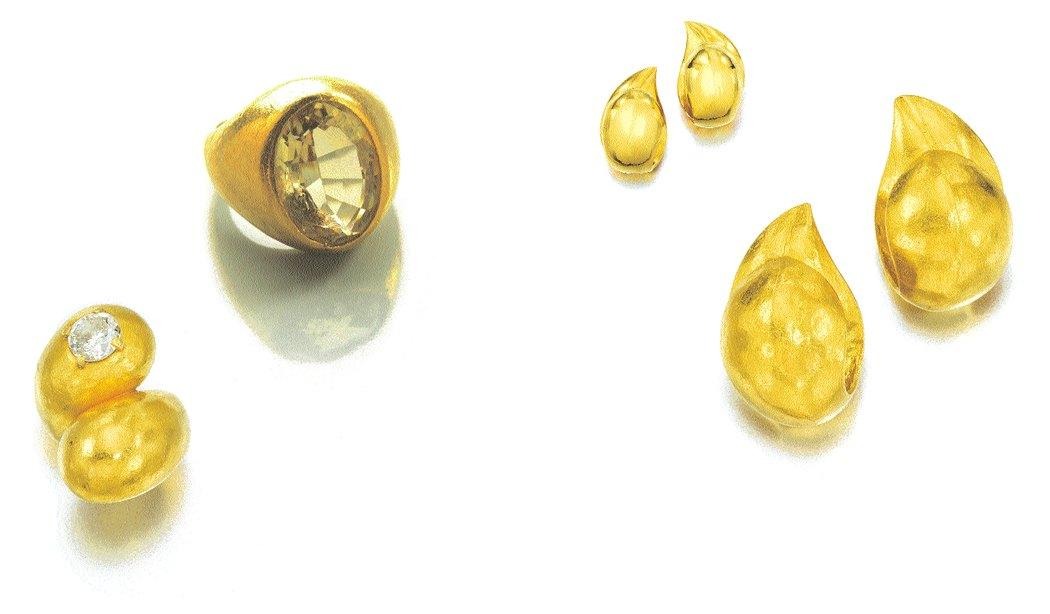
Rings and brooches in hammered yellow gold, their volumes inspired by the turban and the boteh. Suzanne Belperron’s own jewellery box.
The maharajas' necklaces and rough emeralds
Spherical or ovoid stones, smooth or fluted, are a hallmark of Indian jewellery: in India, the making of bead-shaped stones goes back to the fourth millennium BC. The maharajas' necklaces, with their multiple rows covering the whole chest, inspired Suzanne Belperron's sautoirs and necklaces of irregular baroque stones, merely polished, uncut and strung like worthless beads, in the manner of princely jewels.
Several pieces from her estate bear witness to this: a sautoir of rough polished emerald beads of varying sizes, from which hang two detachable tassels, or a necklace of seven turquoises, the emblematic stone of the Himalayan peoples.
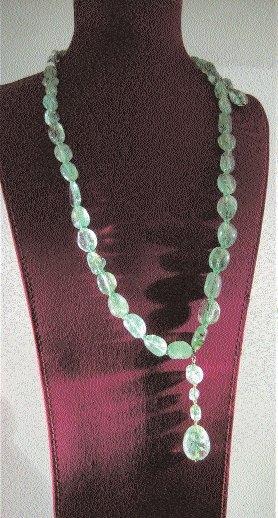
Sautoir composed of emeralds of various shapes, with two detachable tassels. Suzanne Belperron’s own jewellery box, private collection.
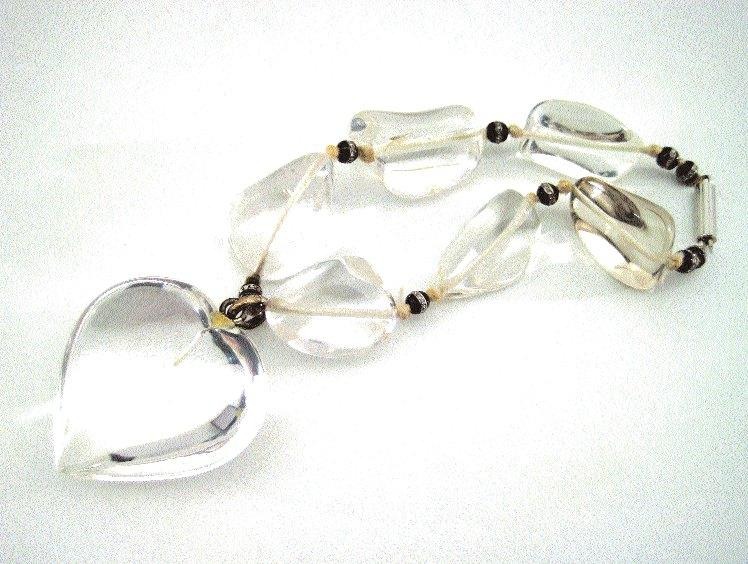
Bracelet of rock crystal interspersed with onyx beads, crossed by a line of diamonds, with a heart charm. Suzanne Belperron’s own jewellery box.
The peacock palette: blue, green and mingled colours
A peerless colourist, Suzanne Belperron could only be enchanted by the multicoloured character of Indian parures, which combine stones of every hue. Many of her designs derive from them, such as her Plastron necklaces of semi-precious stones of all colours.
The pairing of blue and green, inspired by the peacock, India's totem bird, suggested to her jewels of emerald and sapphire, of jade and lapis lazuli. Like a mineral embroidery, the subtlety of her pastel combinations, pink, jonquil, pale green, cherry, mauve, inherited from Persian civilisation, further enriched her palette.
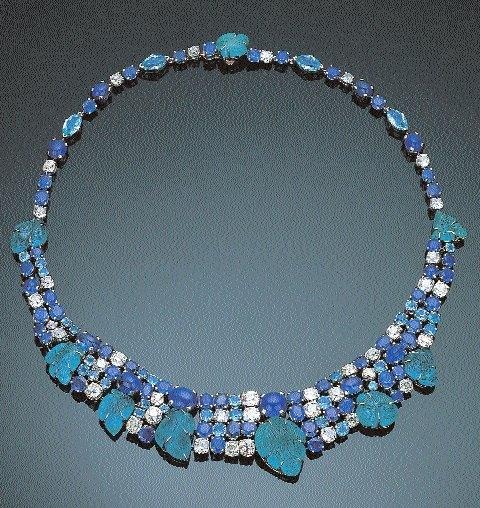
Plastron necklace of diamonds, sapphires and aquamarines, enhanced with carved aquamarine leaves. Maker’s mark Darde et fils.
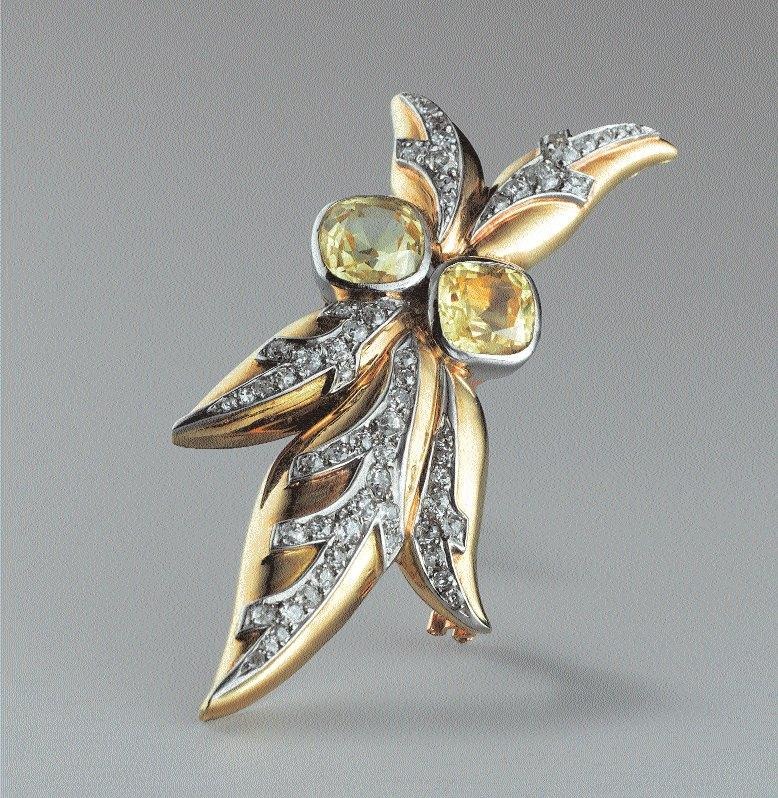
Brooch with stylised foliage in yellow gold, outlined with diamonds and set with two yellow sapphires.
An India reinvented
From India, Suzanne Belperron copied nothing. She brought back a grammar of forms, the boteh and the turban, a way of stringing rough stones like princely treasures, and above all a colourist's daring, that of the peacock and of mingled hues. By “Europeanising” this tradition, she extended it rather than imitated it. As with her creations inspired by Africa or by rock crystal, only the archives rediscovered by Olivier Baroin make it possible today to authenticate these pieces, which their lack of signature would otherwise render impossible to attribute.